sapphire with inclusions of mic

Hello Troy,

Thank you very much for your analyses and encouragement.
I would like to add an important detail: the alumina purity of the blue mass has already been measured at around 98.5–99% Al₂O₃. Based on your remarks, the white corundum appears more “noble” because it contains less Fe and Ti. Could I then expect a purity close to 100% Al₂O₃ in this white zone?

From my research, the Egyptian sapphires seem to show the highest alumina purity ever reported, close to 100%.

I would be very interested in your opinion on this point.

PS:
I have nicknamed this sapphire “Le Noble”, not because of classical beauty or material value, but because for me, nobility is something deeper. It is not only about perfect aesthetics, but about carrying a history, keeping dignity beyond superficial judgments.

Someone once called this stone “ugly,” probably because their vision is limited to transparent gems without inclusions. Yet, as you may have noticed, so-called “flaws” and inclusions are now sought after by collectors, because they give each stone a unique character and a scientific and aesthetic identity.

That is why I consider this piece noble: it tells its origin, its transformations, and it retains a singular presence that perfect transparency does not always offer.

To illustrate this idea, I want to mention a fascinating example: the starred diamonds (asterism diamonds). These stones contain clouds of inclusions shaped like stars. Once considered imperfect, they are now highly prized by collectors because these inclusions create a unique beauty and reveal the crystal’s inner story. I see a similar analogy with my sapphire: it is precisely its inclusions and internal textures that make it unique, beyond the standards of classical gemmology.

Best regards,
1 Like

je vous remercie pour les photos. Comme usualment c’est tres difficile de l’identifier pas les photos seules. I think that the feldspar is albite/oligoclase from its white and sugary texture. Orthoclase can also be white… neither type for feldspar is completely diagnostic. However, albite would favor a desilication process, leaving behind hi alkali, particularly sodium.. Corundum crystallizes first out of a desilicated pegmatite at high temperature, with residual silica forming aluminosilicates at lower temperatures. .. the blue corundum probably crystallized first, absorbing trace element coloring agents, leaving behind pure white corundum. That would also explain the white corundum fracture filling. Mica crystallization occurs when temperatures drop even further, with the addition of water..Co-crystallization of margarite and corundum should not happen in the early stage of crystallization. It could form as the pegmatite mass slowly cooled, with residual water and oxygen derived from hydroxides. These late stage fluids could have penetrated between the interstices between the corundum scales and microcrystals, creating the mica. If the mica is margarite, it won’t flake apart or crumble either. Margarite is a “brittle mica”., it has aluminum substition for silicon within its sheets…If the mica is also in the feldspar, that would also indicate that the mica was late forming. If you have feldspar with mica, Viola!.. you can test the feldspar destructively if necessary to identify the mica…So far as cooling time is concerned. Silicic pegmatites once where thought to slowly crystallize, allowing for very large crystals,. A few more recent theories show that crystals can grow explosively, with cooling times from days to weeks…this theory is still very controversial… A better analogy to your massive corundum is emery deposits, which are massive impure corundum, with associated minerals being magnetite, magnesian spinel and hercynite in solid solution.. These deposits form from hydrothermal fluids deep in the crust. cooling times are slow, the result of continental collisions.. on the order of thousands to millions years.. your specimen is a slow cooling one. it’s almost unique.. it’s a rare and unusual specimen of scientific interest. Carving into a work of art would give it aesthetic interest and a high value, in and of itself, as corundum is so difficult to carve. Bonne journee, et merci bien a votre recherges et vortre travaille.

2 Likes

the white sapphire probably is the purest. I say so because I think that the blue sapphire absorbed the chromophore trace elements. The white part should show the lowest trace element profile across the board. I should also add that the blue and white crystallization order that I initially wrote could be the reverse. Pure corundum can also crystallize first, followed by blue, which absorbed the residual trace impurities.. Both arguements can be stated.

The presence of mafic trace elements is not absolutely diagnostic for desilicated magma.. Fe/Ti charge transfer colors sapphire blue. V, Cr is accessory to Fe and Ti. Mg, Ca are also mafic elements. However, the Mogok rubies and sapphires were formed in impure dolomitic marble..no silica but higher Ca.and Mg…Ga/Mg ratios with high Ga distinguish broadly, basaltic and metamorphic sapphire..Ga is high in basaltic, low in metamorphic. With desilicated granite derived magma and pegmatite magma, the Ga/Mg ratio will be mixed, intermediate or overlap into both fields. Heavy oxygen 18/ to 16 0 ratios have the ability for further discrimate… delta 0 18 is uniform in the mantle, delta 0 18 is much more variable in the crust, tending much lower, with 16 0 predominating in water and crustal water..Th isotopic ratios of heavy to light oxygen in the corundum should have a crustal oxygen signature… even if a granitic magma is desilicated by intrustion into CRUSTAL mafic and ultramafic rocks… such as obducted oceanic slabs (mafic to ultramafic), eclogites (from subducted oceanic crust)…delta 0 18 is heavier for basaltic/ magmatic sapphires, including syentitic magmatic sapphires. This kind of analysis can also apply to the mica. The mica would crystallize last, having a crustal water signature. The only way that I know of to do these kinds of discrimnants is LA-ICP-MS…Raman can to only a limited extent.

A word about Feldspars: Alkali feldspar contain Na/K.. only at high temperatures can they form a disordered solid solution. As feldspar cool and crystallize, Na and K are incompatible in a tectosilicate structure. The ionic radius of K is larger than Na, Cooling and crystallization separates out K feldspars from plagioclase. Plagioclase is a solid solution rangeing from all Na Albite to all Ca anorthite. The electronic configuration of Na and Ca are the same. Ionic radius is essentially the same. Plagioclase, including albite crystallizes first before K feldspars. A mixture of plagioclase and K feldspars separates out into perthite.. layers of Na/Ca feldspar alternating with layers of K feldspar. The effect can be macroscopic and visible to the naked eye.

2 Likes

Hello everyone,

I would like to share with you an exchange that means a lot to me.
I was fortunate to receive a reply from Jan (SM Share Management AG), the company that holds several Guinness World Records for sapphires (trapiche, cabochon, sculpture). I want to thank him here for the time and advice he kindly gave me.

In his message, he reminded me of several key points:

  1. The certificate I had obtained was based on a very small sample of 0.34 g, which does not necessarily reflect the entire stone. For real value, the analysis must be made on the whole specimen.

  2. A certificate only has international recognition if it is issued by Gübelin (Switzerland) or GIA (USA). For example, even Guinness World Records only accepts reports from these two laboratories.

  3. Most very large specimens are actually sapphire aggregates, and only the top laboratories can confirm if a stone is truly a massive corundum.

  4. Finally, he asked me to clarify what my ultimate goal with this stone really is.

From this exchange, I realized that my work with Le Noble goes far beyond gemology and must be seen as part of a scientific and international approach. That is exactly what I am pursuing with ongoing analyses (SEM-EDS, tomography, petrographic studies).

Of course, I know it would be possible to extract a very large cabochon, showing a remarkable silky effect. But that is not my objective: my approach remains focused on the scientific understanding and official recognition of this unique specimen.

Once again, many thanks to Jan for his advice, and thank you all here for your enriching discussions that help me move forward step by step.

2 Likes

good work so far…!!! congrantulations. The usual procedure for whole rock analysis is destructive.. multiple large samples are crushed into powder, elements extracted by acids, then run through LA-ICP-MS… LA-ICP-MS can be done almost non destructive with multiple surface sampling.. however, that would require a very large number of sampling sites on the stone and the feldspar. Getting a sample of the mica, would be difficult, as it’s intergrown with sapphire
and feldspar. If a small piece of mica is on or near the surface, that could be ablated off, with the adjacent corundum sampled and substracted out…

Si vous vivez à Paris, je pense que votre meilleure chance d’obtenir une analyse minéralogique avancée est de trouver un universitaire qui fait déjà de la recherche sur les processus métamorphiques et de l’intéresser à faire de la recherche sur votre pierre. Avez-vous contacté la Société Française de Minéralogie et Cristallographie à Paris ? Le meilleur choix est d’avoir la chance de trouver un universitaire qui étudie les processus métamorphiques peralumineux, il pourra peut-être analyser votre pierre dans le cadre d’un projet de recherche plus grand. Vous n’aurez pas à dépenser plus d’argent pour des tests coûteux tels que le LA-ICP-MS.

If you are living in Paris, I still think that your best chance to get an advanced mineralogical analysis, is to find an academic who is already doing research into metamorphic processes; and get them interested into doing research into your stone. Have you contacted the Societe Francaise de Minerologie et Cristallographie in Paris? The best choise is to have the chance to find an academic person who is studying peraluminous metamorphic processes, they might be able to analyze your stone as a larger research project. You won’t have to spend any more money for expensive testing such as LA-ICP-MS.

1 Like

a cabochon would be attractive as an end point to your research. However a sculpted piece of art would make it even more valuable. It could be sculpted to show off parts of the silky sheen effect. Best wishes on finding more scientific information and best wishes for an eventual piece of art.

un cabochon serait attrayant comme point final à votre recherche. Toutefois, une œuvre d’art sculptée lui donnerait encore plus de valeur. Elle pourrait être sculptée de manière à faire ressortir certaines parties de l’effet de brillance soyeuse. Je vous souhaite de trouver davantage d’informations scientifiques et de réaliser une œuvre d’art

1 Like

Hello Steve,

Thank you for your encouragement and your precise advice.

The samples are currently under analysis by a highly qualified specialist I fully trust. At the very beginning, I had also approached a mineralogy university in Paris. Their judgment was very harsh — some even told me I was wasting my time and money. But instead of discouraging me, that criticism gave me the determination to continue step by step, with rigor and independence.

When I realized it was truly a sapphire, my first intention was simple: to resell it. I asked the same question anyone would: how much is it worth?
But over time, through research and analysis, I came to understand that its value cannot be reduced to a number. It lies in its geological rarity, in the story of its formation, and in its potential to serve as a scientific and cultural testimony.

Today, my approach is not to chase an immediate valuation, but to document, understand, and transmit. I am moving forward with analyses (EDS/SEM, tomography, petrographic study) and building a solid, transparent dossier without exaggeration.

Yes, it would be possible to extract a cabochon with a silky effect. But that is not my goal. My vision is broader: I see Le Noble as a piece that can be highlighted in an artistic or museum context while preserving its identity as a unique natural specimen.

As history teaches us with other stones, true recognition often comes later. One day, Le Noble may be displayed in a museum, studied and admired not only for its material, but also for the story it carries.

Because the value of a stone — just like that of a work of art — does not reside solely in its immediate brilliance. It lives in the vision of those who recognize it, in the hand that reveals it, and in the collective memory that carries it forward.

Thank you again for your perspective; it helps me to move forward with constancy and determination.

Best regards,
Kadda

1 Like

I’m sorry to hear about your bad reception at the mineralogy institute. Too often, academics take that kind of attitude towards laymen. I myself had a difficult time with local academics at the School of Mines and Techonolgy. I was lucky to find a person who listened to my interests and directed me to further resources. I was also lucky to another one at the University of Hawaii whose papers I’ve read. Both persons encouraged me to study further. However, it wasn’t about identifying a single rock… it was about more general questions about the petrogenesis of akalic rocks. They even provided me with reprints of their papers and in once case her PhD thesis. The professor in Hawaii has retired. The other person became a casual friend. Her interest in petrology was damaged by a politically motivated scandal, when she failed to pass a bad student whose father was a politician and donor to the school, most interestingly we still have remained friends. She quit geology entirely and is now seeking a doctorate in Chrisitan Theology… she won’t answer geological questions but will discuss with me early Church history, and how the Church evolved theologically… As I do have a background in philosophy and European history. we can still email each other.
Good luck and best of wishes. je voyagerai encore a Paris le Aout de 2027. Il y aura une conference sur la geochemie. La Societe de Geochemie Europeanne aura sa conference annuelle a Paris- la conference Goldschimdt. Ca sera le quatrieme temps que je l’attendrai… toutes les conferences de Goldschmidt me plait beaucoup. En 2026, juillet, la confrences sera a Monreal, Canada…c’est assez loin de chez moi mais j’irai non plus…Ce n’est pas essentiel d’etre un academicien. C’est ourvert a tous qui s’interessent. Le francais ici, etait ecrit sans IA assistance. Me Pardonnez si j’ai fait faute avec la grammaire et l’orthographie..je suis aussi un etudiant de francais au niveau intermediaire,non pas avance. Si vous habitez a Paris ca serait une occassion de vous rencontre. Merci encore pour votre recherches…

1 Like

Hello Steven,

Sorry if I went a bit off track in the conversation. In my experience, it sometimes feels easier to get an appointment with a medical specialist than with a geologist or mineralogist :grinning_face_with_smiling_eyes:.

Thank you as well for your message and for sharing your own experience – it’s always a pleasure to read you. I now better understand your journey, the challenges you faced, but also the richness of your exchanges with those who supported you. I find that very inspiring.

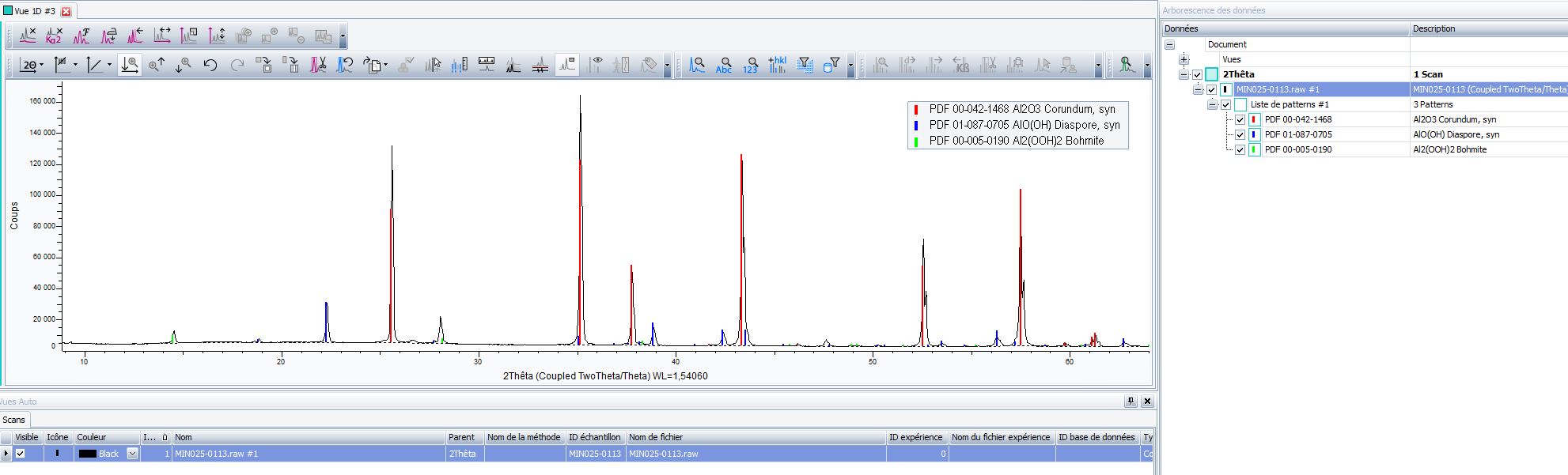
On my side, I recently received new diffractogram results (attached). These analyses bring new information and also raise new questions. They help refine the reflection and comparisons with potential deposits, including Turkey and Macedonia, which therefore remain part of the working hypotheses.

The sample submitted did not show the reflective zones, since these are parallel to the cut: only the sapphire itself was visible.

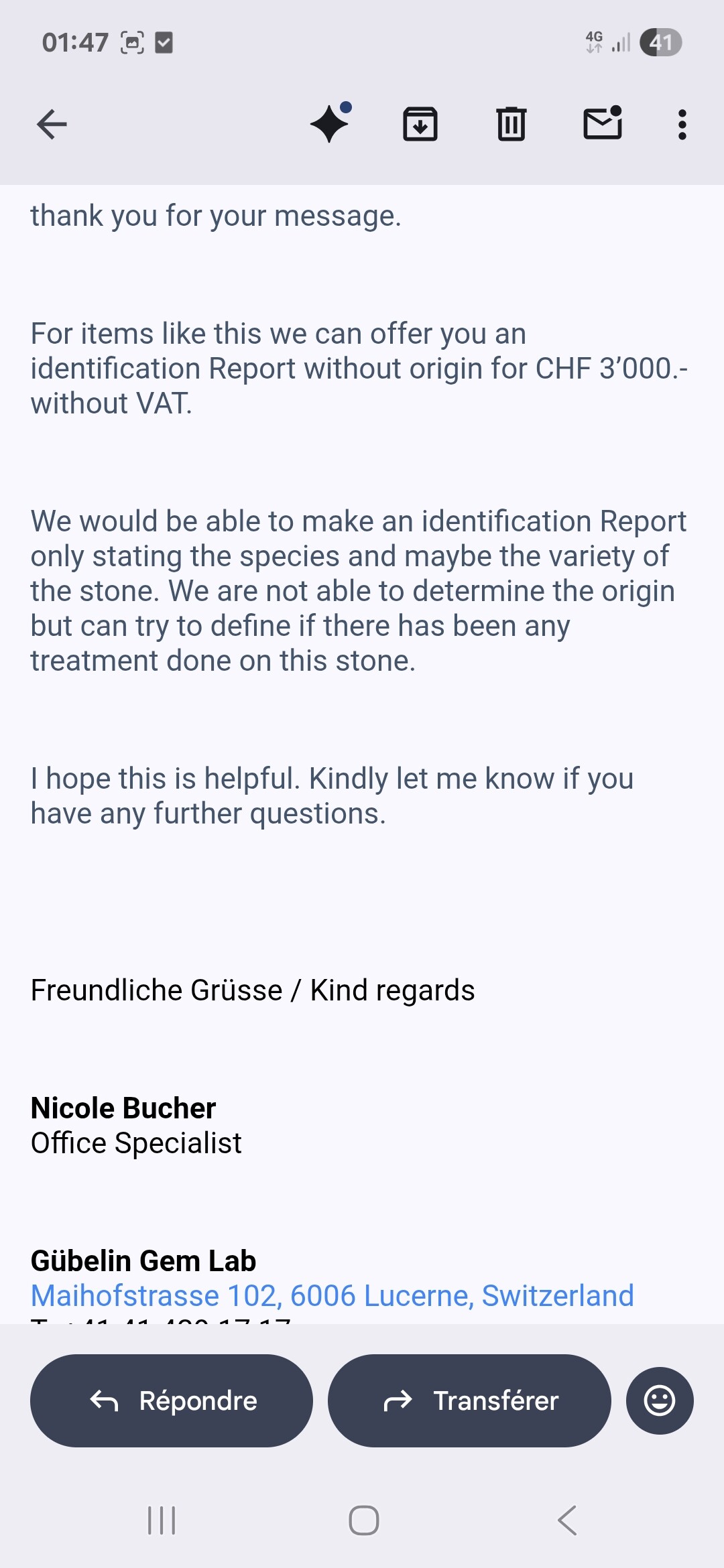
I also contacted Gübelin. They told me that they do not perform in-depth analyses; their certification focuses on confirming corundum and mentioning an optical effect (such as star, silky, chatoyancy), but not identifying the exact mineral responsible.

As I have been asked several times, it is important to prove that the analyzed samples indeed come from this specimen. Today, halfway through this journey, it seems essential to me to have Le Noble certified by a recognized laboratory, to give it official legitimacy. At the same time, I will continue the research and analyses to determine its geological environment, the mineral(s) responsible for the effect, and the conditions of its growth and crystallization.

You will be most welcome in Paris in 2027 – it would be a great pleasure for me to meet you during the Goldschmidt conference. It would be a wonderful opportunity to exchange in person, beyond the messages.

In the meantime, I wish you much success in your research and projects, and I look forward to continuing to share our experiences.

With all my friendship,

Kadda

I made the argument that the blue sapphire formed first, absorbing the impurities. After second thought; it’s more likely that the pure corundum crystallizes first out of pure alumina. Mobile trace elements including light incompatible lithophile elements (LILE) that would soak up silica and form accessory minerals (tourmaline, beryl, alkali feldspar), and mafic elements (CaFeMg) in the metamorphic fluids contributed by the host rock of the intrusion, would be concentrated in the residual fluids, entering the blue part of the sapphire later. Mica would have to form last as the last of the mass crystallizes with residual fluids.

1 Like

Hi Kadda,

I apologize since I have missed the opportunity to respond to your questions above in a timely manor. Pure alumina is not uncommon from natural geologic processes but certainly more rare in its purest form of the “noble corundum”. Most of the colorless sapphires still have some trace elements, albeit exceptionally small traces. If the Egyptian sapphires were near the 100% purity, I suspect they would be optically colorless.

The diffractogram data you just posted to Steven, does add more questions. :slight_smile:

Diaspore was definitely not a mineral I had expected, but could explain the opalescence effect (sheen). The description of them being “beads” adds some weight to that diagnostic as well.

Quite intriguing!

Cheers!

1 Like

Je n’ai pas vu votre dernier message. La corrielle est apparu dans mon dossier spam. Votre sentiments sont tres noble, plus que le Noble meme soi.. Je vous felicite pour tout le travail que vous avez deja accompli jusqu’a present. Vos efforts et sentiments sont plus noble que le “Noble” lui meme. Je vous salue pour tout ce qui a été fait. J’espere que le fin l’equete approche a grand pas…L’identite du mica est la grande question, J;espere que vous le trouverez du pres.
Au fin laissez moi savoir ce que vous trouverez a la fin.
Apropos de Goldschimdt a Paris en 2027,
Il y a toute une série de lectures sur la formation des gisements de minéraux et de pierres précieuses que vous pourriez trouver fascinantes. Je serai présent si j’en ai la possibilité, tant que ma santé le permet. Je suis un vieil homme maintenant. Il est très probable que j’assiste encore à la conférence. Si je parviens à me rendre à Paris, je serais très heureux de vous voir en personne. je vous enverrai ma courielle personelle par message. Après toutes les informations que nous avons échangées, j’ai le sentiment que vous êtes un collègue et un ami, n’hésitez pas à vous adresser à moi de manière informelle…

The next Goldschmidt will be in Montreal, Canada next July, Troy has indicated he might make it. If you are able tp go Montreal next summer, It’s possible that the three of us could meet together.

Merci, encore et bonne journee.

1 Like

Hello Troy,

Thank you very much for your feedback, it’s always very valuable to me.

The EDS analyses show variability depending on the zones: the areas close to fissures or in contact with the gangue display lower values (≈ 78% Al₂O₃), because of the influence of feldspar and mica. But at the core of the specimen, some spots reach ≈ 99.7% Al₂O₃, which confirms the existence of nearly pure corundum zones, comparable to the best natural corundum reported in the scientific literature (such as in Egypt, Migif-Hafafit, where corundum reaches up to 100% Al₂O₃ – Khaleal et al., 2022, Frontiers in Earth Science).

From my research, a question often arises: how can a sapphire be chemically almost pure Al₂O₃ and yet appear blue? The answer is that the blue does not come from a major compositional change, but from infinitesimal traces of iron and titanium. These elements sometimes represent less than 0.1% of the total mass: too low to appear in the global results, but enough to create, through Fe²⁺ ↔ Ti⁴⁺ charge transfer, the intense blue color.

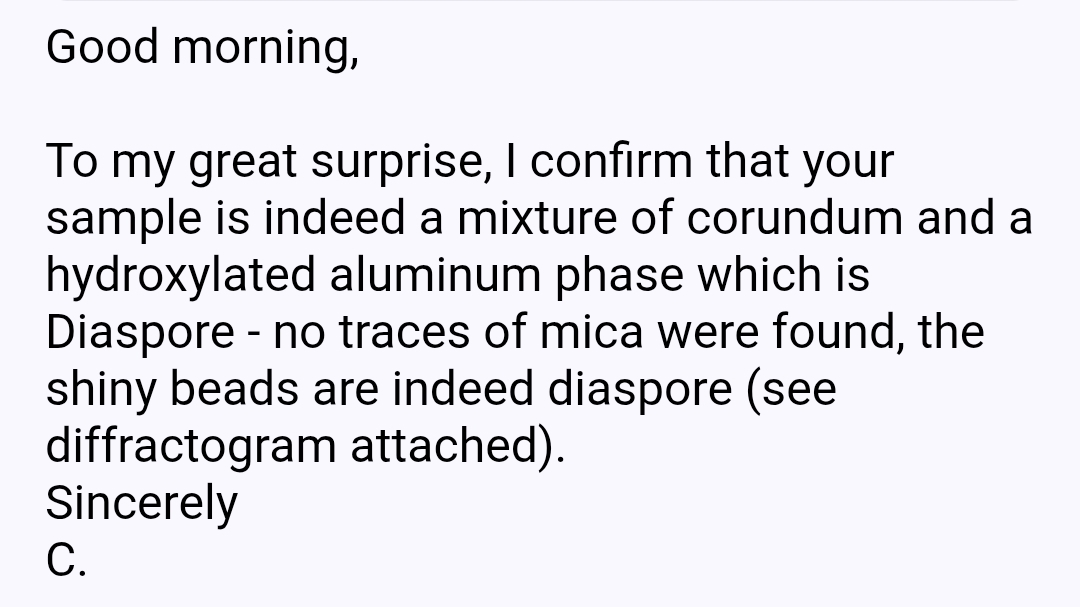
  • The EDS analyses also confirm the presence of mica and feldspar inclusions, while the diffractogram revealed the presence of diaspore and boehmite.
    We are still awaiting further complementary results to refine this overall picture.

Thank you again for your attentive insights, they help me move forward step by step in understanding this stone.

Best regards,

Hello Steven,

Thank you so much for your message, it truly touched me. Your words give me even more motivation to continue my research.

Thanks to this forum, to all the contributors, and to your detailed readings and analyses, this specimen has been able to draw attention and gain importance as a true geological witness. Your professionalism and the valuable information you have shared have been like energy — a fuel that keeps me going forward with my research and investigations.

I know that health is the most important thing, and I sincerely hope you will be able to attend Goldschmidt in Paris in 2027. It would be a great honor and a true joy for me to meet you in person after all our exchanges.

I also hope that Montreal in 2026 could be possible, as it would be a unique opportunity to share that moment with you and Troy.

With all my friendship and respect,

Merci bien mon ami: je suis un amateur moi meme. J’etudie la geochemie seulment pour l’interesse. Quand j’etais un jeune garcon, j’ai m’interesse de collectioner des rochers. Maintenant, je cherche les papiers scientifiques. De trouver les pierres precieuses et de trouver les specimens des minerailles jolies moi meme aux montagnes et aux deserts sont tres difficile. Il faut savoir les conditions geologiques pour les chercher.. Donc, quand j’ai veillie, collectionner des articles scientifiques apros la creations des pierres et rochers m’intresse de plus. C’est plus simple de trouves ces articles que touvers des pierres.. Je serais tres enchante de tu voir, Troy aussi, si c’est possible a Monreal.. En tous cas, je voyagerai encore a Paris en 2027. Les presentations de Goldschmidt sont difficile a comprendre a maniere quantitative, mais ce n’est pas si difficile de les comprendre a maniere conceptuelle. Je les ai trouve merveilleuse. Le premiere conference dont j’ai participe etait a Hawaii, le deuxieme etait a Lyon, le troiseme etait a Chicago. De retourner a Paris sera assez joli. Prague a cette annee m’a manque. Maintenant ou j’habite, il n’y a personne qui parle francais. Les etats unis sont monolingue, pas comme Europe que je trouve plus amiable a cause des personnes que parlent deux, trois ou meme cinq langues…j’ai etudie le francais au lycee, et puis a college, J’ai eu une semestre a Paris. Mais tout cela etait plus 50 ans passe.. de maintenir le francais a un endroit qui est monolingue anglais est tres difficile. J’aime bien parler le francais quand il y a l’occassion. En addition de etudier des systemes petrologiques, maintenir le francais, je commence a etudier l’espagnol. Je voudrais bien d’aller a l’Espagne l’ete prochaine. Il y aura une occultation de soleil complete au nord de l’Espagne le 12eme d’aout 2026. Je suis un debutant d’espagnol, mais j’ai une amie qui voyagerait avec mois qui est bilangue en anglais et l’espagnol, les deux, comme ses langue premieres. La seul hesitation de voyager a l’Europe pendant l’ete est que il y a toujours les grandes foules de touristes et ca ne me plait pas tres beaucoup..les escrocs et les pickpockets sont partout aussi… J’ai deja vu toutes les attractions touristiques, deux fois et cela est assez!..La conference de Goldschmidt est tourjour pres de la premiere semaine d’aout. C’est le temps quand les academciens peuvent presenter ses rechereches. Maintenant je suis en retraite, mais j’ai plus de travaille que j’ai eu de tous ma vie.. il y a les enseigments que j’aimerais suivre pendant trois vies..La facon dont je t’ecris, tu sais que je n’emploi pas le IA pour les traduire. C’est seulment que je sais de francais,et pardonnes moi si je fais faute de grammaire le l’orthorgraphie… encore merci bien pour ton amiete..j’espere toujours que tu tourverais ce que tu cherches a propos de ta pierre. Tu as m’a donne plus de l’intresse de ta pierre et tous les processus qui peuvent le former, et aussi l’occassion d’uitliser francais encore…pour cela je te remercie… Bon journee.

1 Like

Hello Steven,

Thank you so much for your message and for taking the time to share your journey, your experiences, and your thoughts. I am truly touched by your sincerity and passion.

This forum and your detailed analyses give me precious energy. Your words and reflections motivate me to continue this investigation around Le Noble, which for me is both a scientific challenge and a human adventure.

I am now very satisfied and happy with my progress. Thanks to people like you, as well as the scientists, researchers, and collectors I have spoken with or met, I can see that the end of the tunnel is not too far away. I am convinced this project will come to life.

Your background, your memories of conferences, and your efforts to keep practicing French show how much passion for geology and intellectual curiosity can cross borders. This inspires me to pursue with even more determination, so that this specimen may become a true geological witness recognized worldwide.

I sincerely hope that we will have the chance to meet at a future Goldschmidt conference – in Montreal or in Paris 2027. It would be a wonderful opportunity to transform our virtual exchanges into a real and friendly meeting.

In the meantime, I will keep sharing with you the results of analyses, so that we can continue to progress together in understanding this unique stone.

Thank you again, my dear friend, for your professionalism, your humanity, and your friendship.

With all my gratitude,

I’m writing in English to better express myself.. si je t’ecris en francais simple, le resultat ne serait pas si elegant. Pardonnes moi. I also have edited this as carefully as I can.. with help from a a multilingual friend who lives here and has been a teacher of french to me, and a little AI.

Ne laisses jamais un academician ecrases ton esprit en disant que ta pierre ou ta rocher est un deschet sans auncun valeur. Never let an academic crush your spirit by telling you that your stone or rock is garbage and has no value. The very same plain simple rocks they show such contempt for, have built their own careers. Les meme rochers simple et directs ont establi leur carrieres. Les rochers sont les os de la terre. Rocks are the bones of the earth. Without them to study, they would be nowhere. Sans les meme roches à étudier, ils ne seraient nulle part. Each individual rock is a part of a greater whole. Each simple rock has a great story to tell. Chaque rocher individuelle fait partie d’un ensemble beaucoup plus vaste..La terre elle meme a 4.5 milliards d’annees. There is a beauty and poetry to the evolution of each simple rock. L’évolution de chaque roche simple est empreinte de beauté et de poésie. Throughtout the vastness of geologic time, rocks born in fire were thrust up into mountains by enormous earth forces. Dans l’immensité des temps géologiques, des roches nées dans le feu ont été poussées dans les montagnes par d’énormes forces terrestres. They were eroded into mud, sand and dust; then carried to the seas. Ils ont été érodés en boue, en sable, et en poussière, puis transportés vers les mers. The sediments were consolidated into another kind of plain and simple rock. Les sédiments ont été consolidés en un autre type de roche simple. Ils parlents d’une autre histoire. They speak of another history. These plain old rocks were then crushed together into continents, mountains and speak of yet another different history. Ces simples roches ont ensuite été broyées pour former des continents, des montagnes, et parler d’une autre histoire differente. The same enormous earth forces that raised the mountains in first place heated some of them to melting. Les mêmes forces terrestres énormes qui ont soulevé les montagnes en premier lieu ont chauffé certaines d’entre elles jusqu’à les faire fondre. New rocks born out of fire were once more created…De nouvelles roches nées du feu ont été à nouveau créées… Le cycle se répète dans l’immensité du temps. C’est l’histoire de votre propre pierre et l’histoire de la terre elle-même. The very last to be created were ourselves, to wonder and dance to poetry and music of our mother earth and starry skies above us. We too, are part of that creation.Nous avons été les derniers à être créés, à nous émerveiller et à danser au son de la poésie et de la musique de notre mère la terre et des cieux étoilés qui nous entourent. Nous aussi, nous faisons partie de cette création. Nous avons été les derniers à être créés, à nous émerveiller et à danser au son de la poésie et de la musique de notre mère la terre et des cieux étoilés qui nous entourent. Nous aussi, nous faisons partie de cette création. Your stone has its own story to tell about the grandeur of creation and beauty and poetry it brings to us now. Ta pierre a sa propre histoire à raconter sur la grandeur de la création, la beauté et la poésie qu’elle nous apporte aujourd’hui. Only that story is the most important, even if it were a huge pure gem diamond. L’histoire seule est la plus importante, même s’il etait d’un énorme diamant pur. Merci et a la prochaine.

1 Like

That was a difficult read. :thinking:

Hello Steve,

Thank you very much for your message. Your words touched me deeply and made me reflect. I especially appreciate the way you give each rock a value and a story, because you are right: a stone can have many kinds of value — scientific, but also commercial.

On the scientific side, we have already made great progress thanks to the exchanges on the forum. Together we have been able to analyze, compare, and attempt to reconstruct the history of growth, crystallization, and the geological environment of this rock. For me, it was like opening a true open-air museum: I discovered many new concepts, technical terms, and perspectives.

Now, only one essential step remains: obtaining the laboratory results . This will be the key to confirming, in a concrete and definitive way, everything we have discussed and built together.

As for the commercial value, Le Noble is not of gem quality in the classic sense, but it remains an exceptional precious stone of more than 15,000 carats. It could be appreciated for its deep and homogeneous midnight-blue color and its unique shimmering effect: either through the extraction of a large cabochon, a sculpture, or even an original artistic creation. In my view, a glyptician is far better suited than a traditional lapidary to bring out the value of such a specimen.

As for myself, since I do not master these domains, I prefer to leave the professionals to speak and decide on the aesthetic future of this stone. My role will be to give it life in another way: by reconstructing its scientific history and hoping to see it one day displayed in a museum, as both a witness and a true jewel of the Earth.

Warm regards

It’s just a rock.