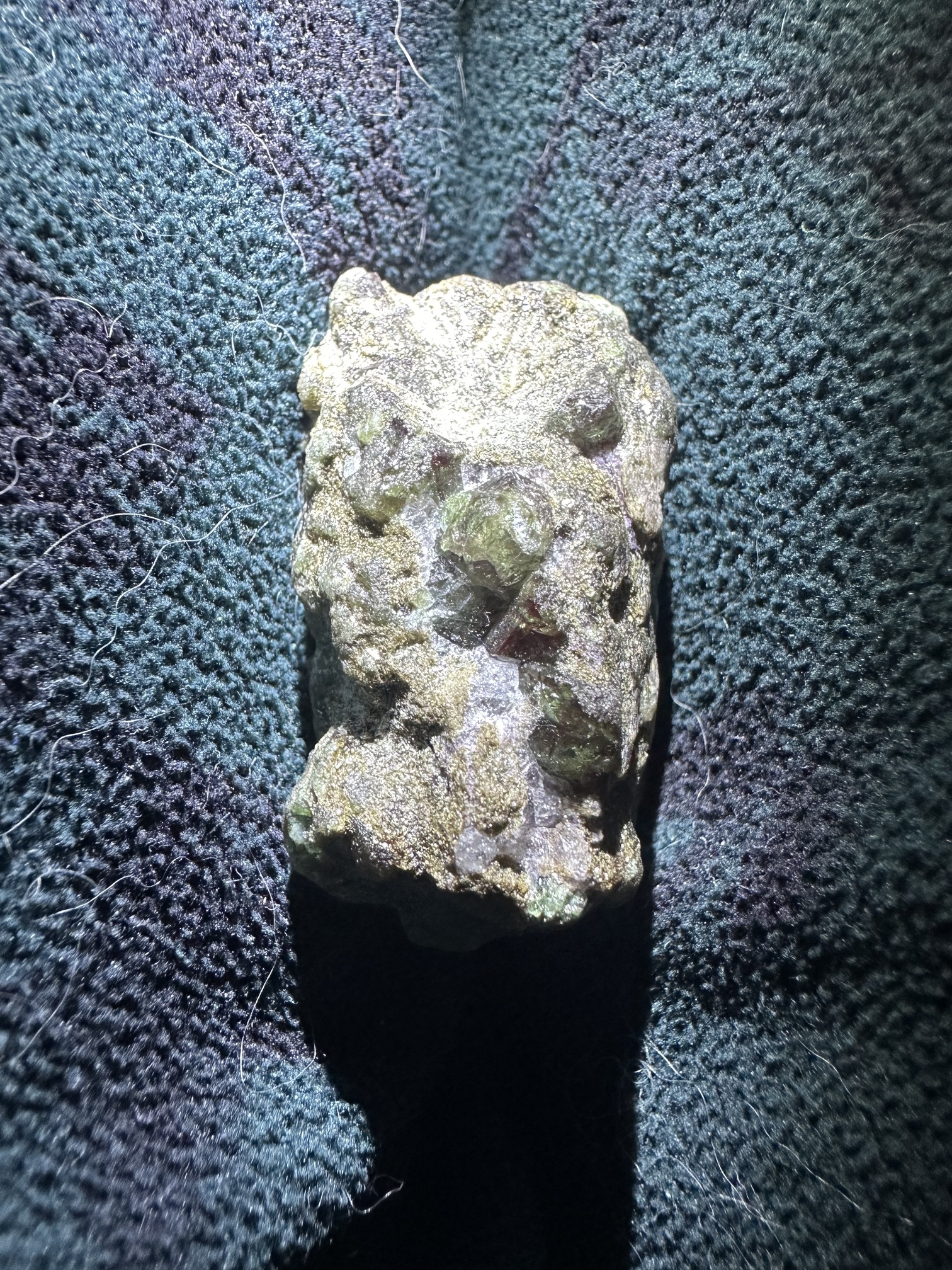
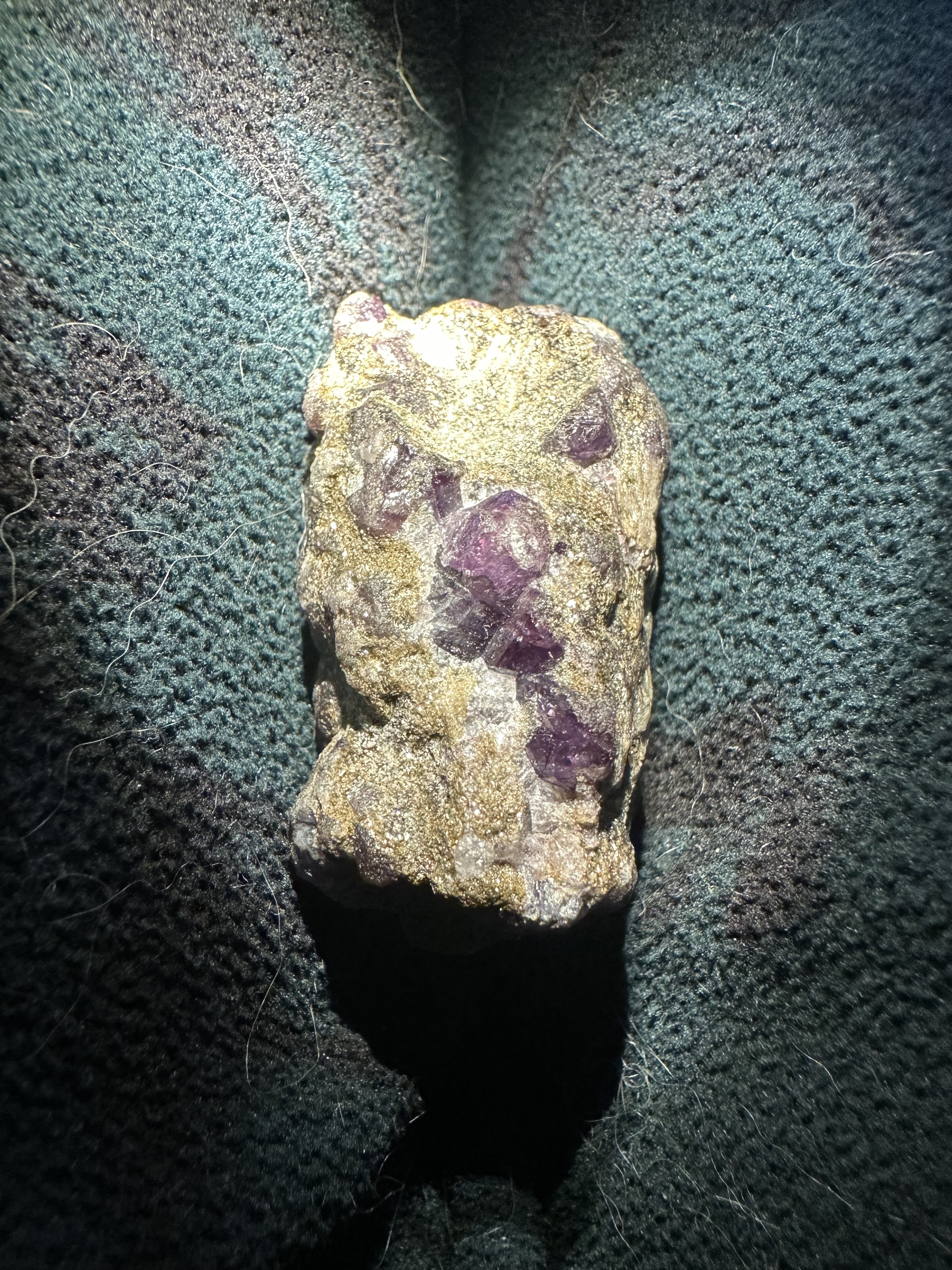
So I bought a pretty nice collection of stones but cut and rough and I want to think this is alexandrite but I have not found a ton of information so far.
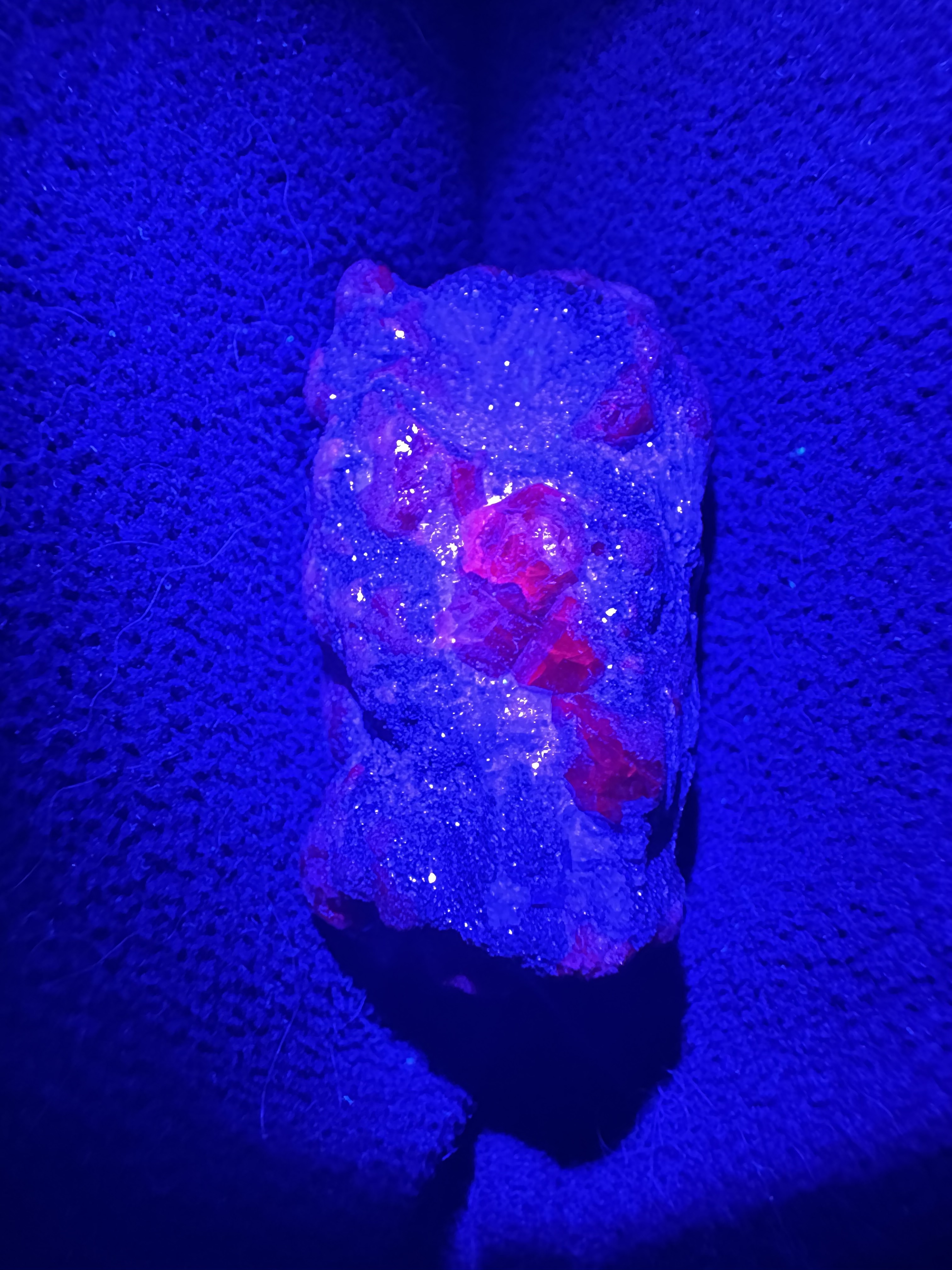
Very much a blueish green in normal light then purple ish. Glows bright red under both 395 and 365. Also bright red under Chelsey filter
Can you describe what “normal light” you used? And what light was used for the second image?
The matrix looks kind of like biotite. It would be good to get some additional images of the matrix as well, as that can help with origin. With the crystals-in-matrix, it will be somewhat challenging to do more definitive diagnostic tests. A polariscope, hand-held spectrometer, and refractometer could provide good information, but might be difficult to perform.
That being said, I suggest this particular specimen be sent to a gemology lab. This will cost some money but, you have a very interesting mineral specimen, and I think (IMHO) it would be worth the cost. Another option would be to approach a local University’s geology/mineralogy department. They can perform some of the same diagnostic tests that a gemology lab can do, however, they may or may not be willing to classify it.
That is a really interesting specimen you have. Please tell us what you find out! Very curious!
Agree…matrix looks like biotite schist. Aluminous schists and derived pegmatities from partial melting can host alexandrite, emerald. Agree that this should be looked at by a mineralogist.
I do not know where it came from exactly. There little to no info or organization to the collection but is obvious that multiple things came from many place all across the world
it’s a problem with a lot of stones- the provenance, which would give you valuable information is always rarely known…the geological setting of the any mineral sample or stone gives the most clues to it’s identity and value. Colored stones are sold in mixed lots and no one knows where they came from. Having a great mineral specimen would be worth more if the locale is known.
Does the fluoresced color persist for any period of time after UV exposure? That is, does it exhibit tenebrescence? If so, it may be in the solidite family (sp?). Just a guess, but the one pic of the purple color in what appears to be natural light appears similar to what this effect looks like with minerals like hackmanite, which I believe is in that family.
(Photochromism - Wikipedia)
I have never seen Alexandrite in the rough before (let alone in a matrix) but I’m curious if this couldn’t be Green Sapphire ?
Obviously, without knowing the size of these crystals or the entire specimen and without seeing any specific Crystal Form it’s hard to tell what it is but Green Sapphires (Corundum) will also Fluoresce Red under UV and they can also be found in a Schist.
Sodalite family minerals are incompatible with high silica peraluminous environments. Your previous find of Hackmanite came from a unique place. (I hope that I have the right person, as I can’t remember for sure who posted the hackmanite photo)… it’s an interesting question about the specimen being corundum… it’s a possibility.
You brought up a good question. You are absolutely right that corundum can be found in schists. Mica schists, including muscovite, and two mica schists can host corundum. The mica indicates a peraluminous state which can result in the crystalization of corundum. Other accessory minerals are aluminous… kyanite, garnet, staurolite, sillimanite, cordierite. Metamorphic grade is medium to lower end of high…the schists are aluminous to peraluminous…alexandrite requires that beryllium. chromium be present. That is an unusual combination, and what makes alexandrite rare. beryllium is held within the last of metamorphic fluids to be crystallized. adding chromium requires a parental mafic mineral. These are extremely rare combinations.
hi there every one . this is a rather interesting peace as i deal with a lot of rough and collector’s grad alexandrite specimens quite often, and thou this all looks wright for an alexandrite there are may different types of color changing and color shifting gems in the corundum / chrysoberyl and garnet families. A few other gems in the family tree branches. It is however important to remember that alexandrite is extremally rear and deposited in only a few places warld wide, So in order to be totally shore you would have to have it tested by density specific gravity and mineral content as we have had some incident’s here in Africa with materials from Zimbabwe that do change color but are not alexandrite, the specimen in question is perfectly placed from appearance and color shift to be the correct gem type of alexandrite.
Needs chromium (Cr³⁺) for the red/green color change.
Also needs beryllium (Be), which is rare in the fluids that form schist.
Requires very specific geochemical conditions: peraluminous alumina + Cr source + Be.
Why multiple stones are extremely unlikely
Rarity of natural alexandrite: About 1 in 10,000 corundum crystals ……you’d almost never find six naturally occurring crystals in the same outcrop.
Geochemical constraints: The combination of Be + Cr in the same schist is extremely rare.
Crystallization sequence: Beryllium is usually the last element to be incorporated from metamorphic fluids, and chromium usually comes from adjacent mafic minerals ……synchronizing them in multiple crystals is highly improbable.
Finding six alexandrite stones in one piece of schist that all show perfect color-change and fluorescence is almost impossible in nature.
you are 100% correct sir: the geochemicall conditions are extremely rare..regional metamorphism must extract Be as a late stage fluid. Cr must come from a close by mafic to ultramafic rock body…desilication by ultramafic rocks and add Cr necesssary conditions to concentrate alumina and Be, in order to form corundum and alexandrite. oxygen isotopic ratios can also be helpful, as well as trace element profiles. LA-ICP-MS is the only way to know for sure.
out of curiosity- are you a petrologist or geochemist? Your approach towards mineral analysis within a specific geologic context is also how I approach these problems. I haven’t found very many people who have the same approach. The favorable conditions for many gem minerals to form is quite uncommon. I am not credentialled in geochemistry so I could learn much more from your contributions to discussions on identification of minerals.
Thank you. I appreciate the comment. I’m not a credentialed petrologist or geochemist; most of what I know comes from common sense, reading, and learning over the years. I try to look at mineral ID analytically and in context because it usually gives clearer answers than just looking at appearance. I’m an artisanal miner and have been involved with Sri Lankan gems, so I’ve picked up a lot through hands-on experience and curiosity.
I am even more impressed by your knowledge given that you an artisinal miner and not an academic. My interest in gems is more petrological and geological rather than the gemological. However, economic geology also applies to gemstones as well as ore deposits. Most deposits of pegmatites and hydrothermal veins are barren. The processes that concentrate trace elements into gemstones are nearly unique. The same processes apply to orogenic gold deposits. I will look forward to more of your contributions in the future.
Thanks again……I really appreciate your kind words. I’m certainly not an expert, just someone who enjoys learning and trying to understand things as best as I can. I’ll probably be more in the background most of the time, but I’m glad if anything I shared was useful.
Ywaraj has put your rough into a suscinct perspective. Chrysoberyl/Alexandrite is very rare. Corundum is a stronger possibility, Unless you can remove a single small crystal for testing- specific gravity, it will be very difficult to know what you’ve got from the hand specimen. If you can find a local university or community college nearby, it could be identified by a minerology expert within a geology department. Local rockhound clubs often have an expert also. A jewerly store with a professional gemmologist might also help. There’s no harm in asking. Since the material is rough, a scratch test for a mineral harder than quartz will also help. Crysoberyl has a Moh’s hardness of 8.5, corundum is 9. Carborundum (silicon carbide) will barely stratch the crystal with hardness of 9.4-9.5 Good luck on the ID, let us know what you find. Thanks.

 . this is a rather interesting peace as i deal with a lot of rough and collector’s grad alexandrite specimens quite often, and thou this all looks wright for an alexandrite there are may different types of color changing and color shifting gems in the corundum / chrysoberyl and garnet families. A few other gems in the family tree branches. It is however important to remember that alexandrite is extremally rear and deposited in only a few places warld wide, So in order to be totally shore you would have to have it tested by density specific gravity and mineral content as we have had some incident’s here in Africa with materials from Zimbabwe that do change color but are not alexandrite, the specimen in question is perfectly placed from appearance and color shift to be the correct gem type of alexandrite.