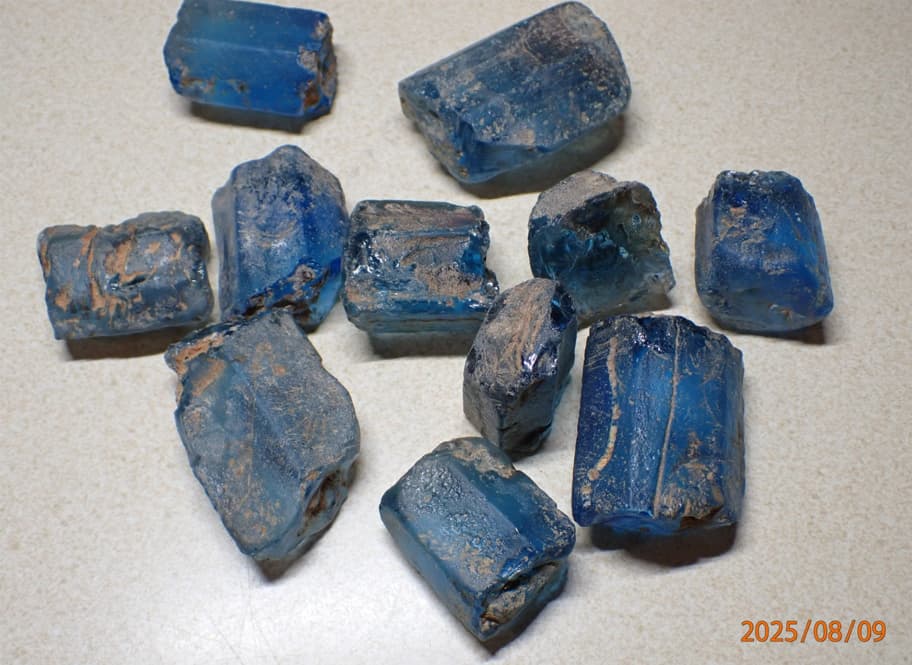
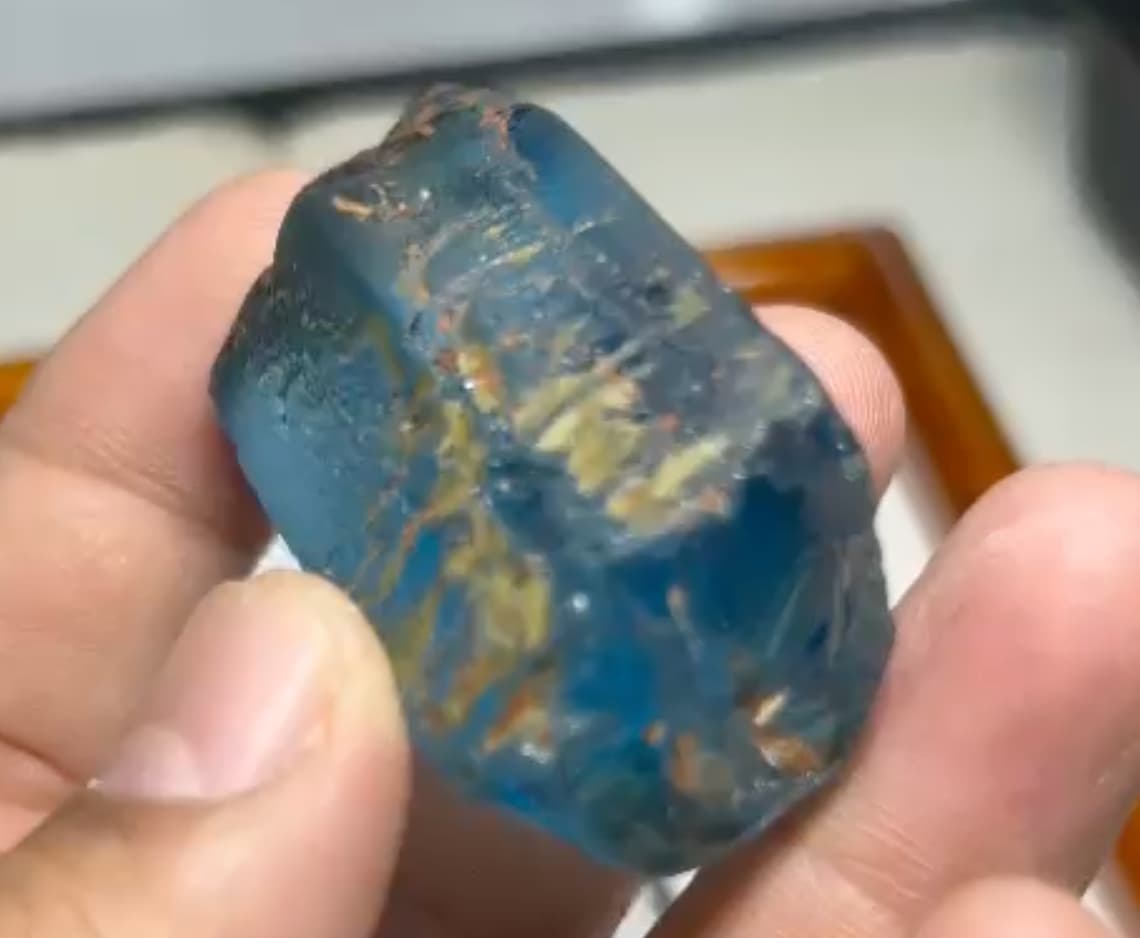
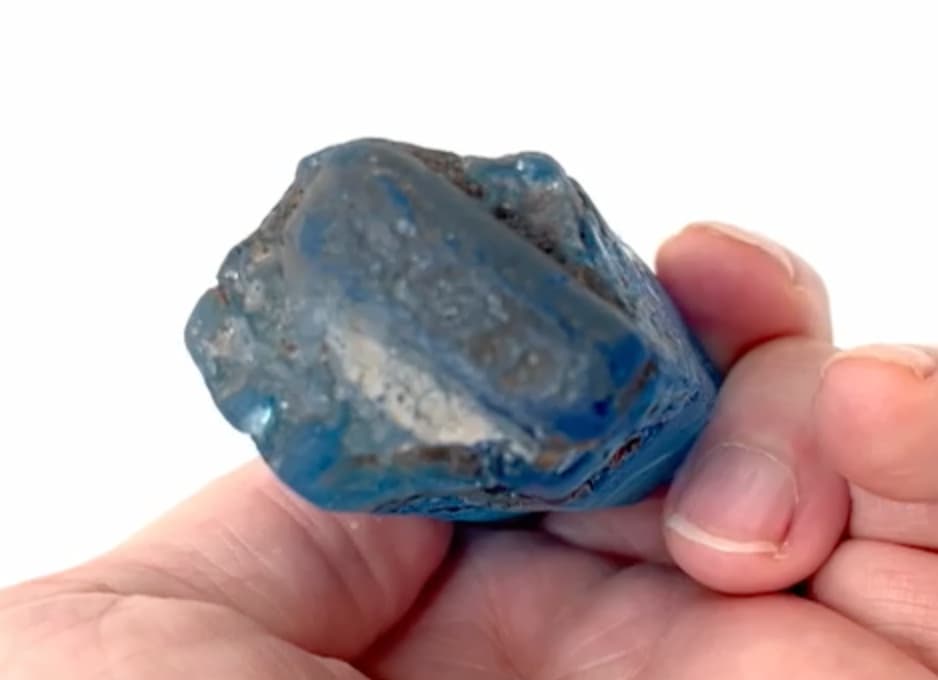
Although this material has conchoidal fracture and appearance of old mining slag… the flat surfaces (faces) seem to come together as if it is a 2/m monoclinic crystal… not glass.
Does anyone have any idea of what this material might be?
Although this material has conchoidal fracture and appearance of old mining slag… the flat surfaces (faces) seem to come together as if it is a 2/m monoclinic crystal… not glass.
Does anyone have any idea of what this material might be?
Hi Dion,
They have a very nice blue hue. If they do belong to the 2/m Monoclinic habit, there is an extensive list of minerals to base-line the candidates: Monoclinic List
Have you done any diagnostics? (Specific Gravity, Hardness, Streak Test) RI and Spectroscope observations would help.
Do they react to UV light? How opaque are they? Can you back-light them and see light passing through them? Do you have a Chelsea filter and/or dichroscope?
Some additional data would definitely help narrowing down the list. 
Cheers!
-Troy
These pixels look like blue apatite to me. We have this in Bahia
apatite is hexagonal.
These crystals look hexagonal to me
Could be… a few seem to have an 010 face that is larger than the 120 faces… which would make them monoclinic… if those faces are the same size…then yes, the crystal become hexagonal… are to tell from the photo. The person who sent me the photo has decided to send me two of the “crystals”… so I can test them and get better info than what we can see from his photo.
If hexagonal… and they are blue apatite … that would be knew for me. I have seen lots of blue apatite, but never encountered large “fat” blue apatite crystals. He said he got them from an African dealer… so I will post again when I have more details.
Notice the inconsistency of the angles between crystal faces? Looks suspiciously like blue glass shaped to imitate natural gem material. Many of these were sold in Bangkok earlier this year.
I’d guess glass. There is a class of ancienr indo-pacific beads made from around 200AD- roughly the early colonial period that is of a very similar color, and I’ve seen stratified and mosaic glass eye” beads with a similar color in the center of the eye. glass beads and their raw materials (rough glass ingots, various fluxes and sands, etc) were wildly traced, from Bali to Mali, as I once heard it said, and the raw stuff would be melted and used for beads and other glass items, and if colored, it could be made to look black. This is just a guess, of course, but if that was found in asian, especially from southern china down through java (what was the Funan region, it’s likely glass).
I cut thin slices of my exact same material so could exam in my petrographic scope… blue coloration is in swirls between clear glass area.. and the “glass” is slightly biaxial, apparently from stress induced by quick cooling. I agree with some earlier reply that it is the “fake material” that was generated in Indonesia for quick sale over the web. I also checked the SG and RI… both match normal old glass.
Mr. Bergman’s (@jbergman) observation was spot on!
Good to know they have been identified! It’s unfortunate for your associate. Hopefully, they can recover their funds.
thanks for pointing it out. you we exactly right!