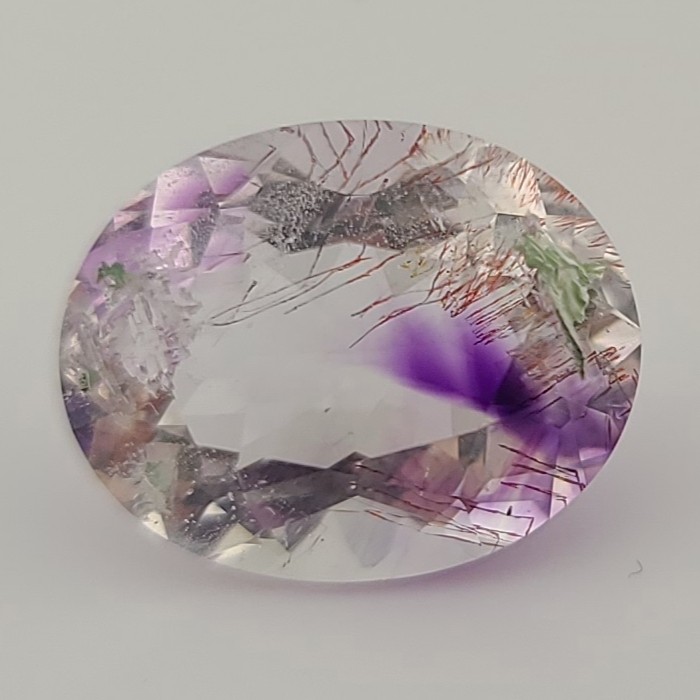
I have a couple of “Super 7” facetted stones that after some digging on-online, may not be actual Super 7’s.
The information so far, indicates the real Super 7 material only came from a singular location in southeastern costal Brazil. The mine has been flooded for some time. Other locations have claimed to have discovered additional pockets of this material but the argument has been… if it doesn’t have the original seven minerals (including the host quartz) it is not technically a Super 7.
They are very interesting stones. Yet not one of mine seem to contain all seven of the original minerals (Amethyst, Clear Quartz, Smoky Quartz, Cacoxenite, Goethite, Lepidocrocite, and Rutile).
Here is a 7.22ct oval stone with some Amethyst zones, two amorphous opaque green solid inclusions (???), some negative crystals, acicular Rutile, and some amorphic red string-like globular inclusions of lepidocrocite or hematite? 
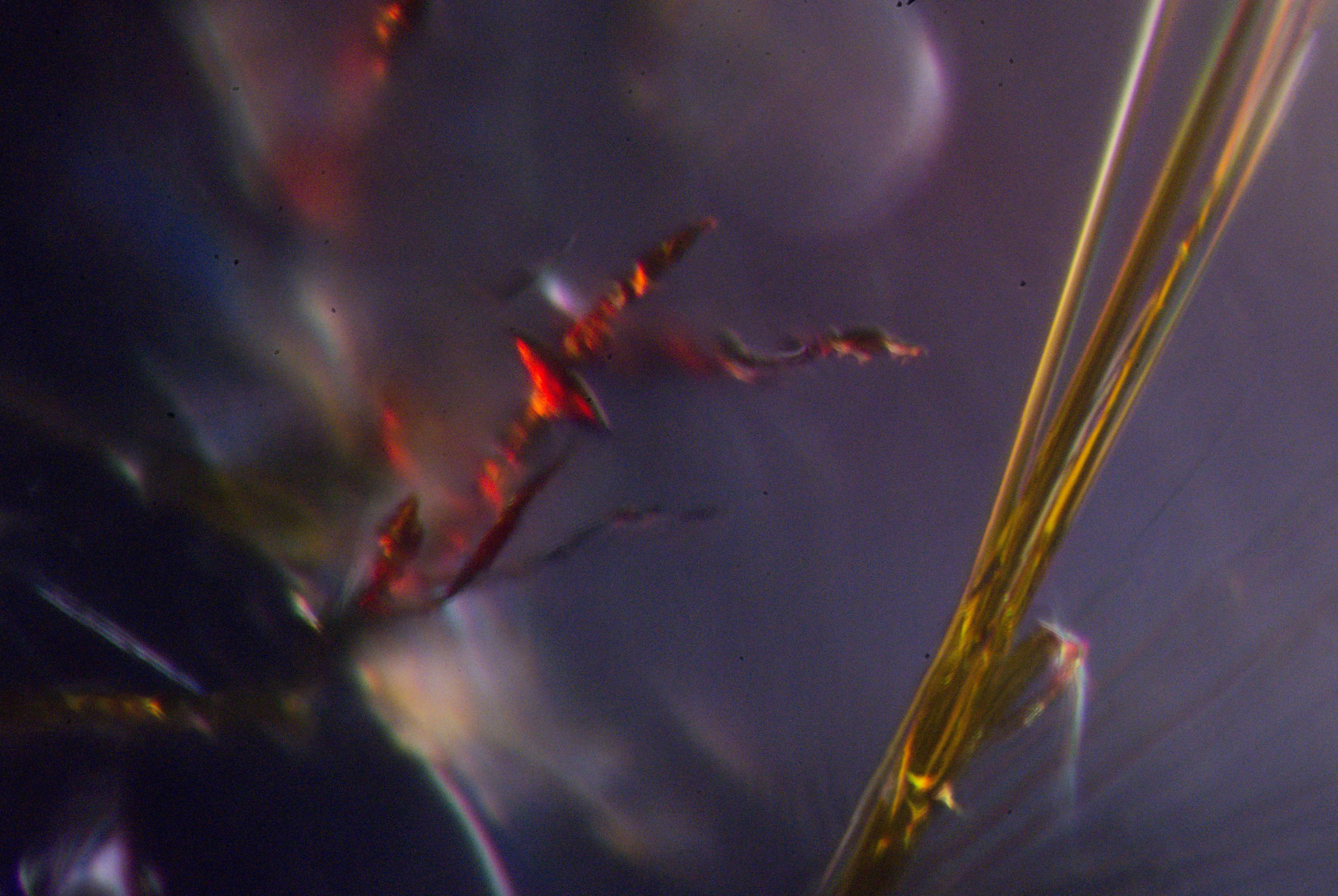
First attempt at focus-stacking with a modified microscope build…
Golden rutile and the red semi-acicular inclusions I think are hematite versus lepidocrocite
Does anyone have geologic references on this material? The on-line sources seem to be mainly focused on the metaphysical side. I haven’t found much information tied to the three big labs or geology forums.
Appreciate any help on the literature.
-Cheers!
Here’s more from AI- phosphorus in the mine.
cacoxenite in the espirto santu mine
The presence of
Cacoxenite in the original
Espírito Santo
deposit is one of the most debated topics in mineralogy. While the “Super 7” trade name require its presence, many geologists argue that true Cacoxenite is extremely rare or even chemically impossible in that specific environment.
1. The Geologic Controversy
-
The Phosphorus Problem: Cacoxenite is a phosphate mineral. Geologically, it is rare for phosphorus-rich minerals to form simultaneously with Amethyst, which typically crystallizes in phosphorus-poor hydrothermal environments.
-
The “Goethite” Theory: Most modern mineralogical studies of stones from Espírito Santo suggest that the golden, fan-shaped “tufts” are actually Goethite that has been colored golden-yellow by iron oxidation, rather than true Cacoxenite.
-
Historical Naming: The name “Cacoxenite” was applied to these inclusions in the late 20th century before rigorous chemical testing was performed. By the time it was questioned, the name was already a staple of the Melody’s Stone trade.
2. How it Appears in the Mine
If accepted as present, the Cacoxenite in Espírito Santo specimens displays unique physical habits:
********************************************************************************************
Me– The initial reports of phosphorus by visual analysis from the late 20th century, have been refuted by more recent studies, using IR and Raman. No phosphorus spectra have been seen on second look. What appears to be cacoxenite is goethite. Lepidocroite is a polymorph of goethite. Changing fluid composition alternated between conditions for goethite and lepidocrocite formation. pH, oxidation conditions, kinetics determine the difference… Raman has actually identified the lepidocroite as hematite. Hematite would account for the red color.
1 Like
Thanks Steven!
My initial search used “Super 7 quartz” as the keyphrase. It definitely was not specific enough to encourage a geologic literature result.
I did some AI searches for lepidocroite vs hematite and that helped with follow-up observations I did on the red inclusions. In this specimen, they have minimal angular features and more globular-like tubular structures. Hematite has been known to form flat “platelet” type inclusions in quartz.
More images and focus-stacking attempts are underway.
The microscope is still a work in progress. Still have to optimize the depth of field / field of view ratio. Will then be able to calibrate the optics before installing the spectroscopic instruments.
1 Like
Overall I think this is a rare watery quartz/ameythyst pegmatite. fluctuating conditions in the fluid in regards to pH, trace element and iron content, oxidation potentials, kinetics of crystal formation, leading to different mineral inclusions being incorporated into the crystal lattice. The most certain thing that we can be aware about is that phosphates are not present. If you can confirm P with spectroscopy, it will be a coup. If confirmed by an academic lab, bingo, you can publish.
Unfortunately, the provenance for this stone is currently just “Brazil”. The stones I have, all contain similar red inclusions like this one although a few have the classic platelet style hematite, but all have the generic “Brazil” locale.
I am going to try tracing the stones origin through the chain of hands…but I’m not confident any are from the Espírito Santo region.
Cheers!
1 Like
Even if it is from that mine, phosphate should not be present. The value lies in its trade name.
1 Like