Your project could spark more interest and bring more inquiry into the field. The topic is so vast and complex. You could be working on this fo the rest of your life. The farther you back in time, the more blurred the lines become. During the bronze age, written records are few and far between. If you extend the time line before predynastic egypt, there are none, only archeological evidence, which is subject to controversy. All I can say is that you’ve taken on an opus magnus. It will cause controversy, but controversy is what drives research forward…the main problem will be the academic types. It takes a lot of new evidence to push them out of their established mind sets. However a few might take it more seriously and follow through. Good luck
I am in europe now so I won’t be actively writing. As your speciality is paleogenetics, DNA trapped in amber might be a clue. I’m not thinking about Jurassic Park, but just pollen and other DNA containing organic material that would have stick to ancient tree sap. The DNA would be fragmented into little pieces… Putting them together would be a herculean task requiring the application of AI to help sort through the pieces and match them up. But It has been done before and published in layman’s terms in an article by Scientific American I think within the last year…I didn’t bother to find the real research papers behind SciAm’s simplification and condensation of all of the research papers that this project generated. Don’t have the time nor the inclination to do that as my time has been taken up by other matters. However, I still think that you are on to an incredibly rich and complex topic. Something should be published in a widely read reputable journal to further spark interest by the academics… Standard theories and ways of thinking get fixed and need to be shaken up by real data. Best of wishes and best of luck to you… take it to the max!
Thanks for the feedback, it’s helpful to know that you find merit in research of this type. And never any pressure to reply; all good with me.
Re. amber, DNA can be extracted, and it usually exceptionally well preserved in amber (almost singularly so), but i whole genomes needed, a lot can be algorythmically reconstructed, and you don’t need a huge number of markers to plot most organic entities in a phylogeny (which gives you rough chronology/date). But like similiar exercises with bone, coral, etc, dna an only tell you them the material existed, not when it was worked, it can sometimes help to geolocate origin, but there are better methods for that (isotope and protein analysis, for example).
I’ve moved away from trying to get a exact locations of origin for a couple items, it’s a weaker case than common, known sources of origin for may items; it tells the story better.
I can see no means to find out when it was worked except by archeological methods. An isolated bead can’t tell you anything about date of working it… one that is buried along with other artifacts may give you a date to when it was buried but not when worked… yu have a problem… how can it be solved?
on one of the recent news letters, there was a piece on lapis lazuli… it showed an ancient insciption on a piece of lapis that looked semitic… babylonian or more likely assyrian. afghanistan lapis is the only source of the stone that I know of. therefore it would be easier to trace old trade routes by following lapis that other stones with multiple provenances. The oldest piece was from 7500BC found in the Indus Valley civilization…it had to have come from Pakistan or Afghanistan, where the mining districts overlap.
Lapis is indeed an odd thing. Lapis stones were all over the ancient world from time immortal but it’s hard to really say for sure if there were any other significant sources. That itself is odd to me, there are a lot of places on earth that have been subject to one-off geological phenomena, but lapis, if truly exclusively endemic to Afghanistan, seems almost singular in that regard.
It’s likely there are a few jaspers that can probably be traced back to a single location, due to a confluence of very unique organic and geological circumstances, and maybe some turquoise and other stones; it’s really hard to say since stones have been traded since literally the dawn of human memory. But lapis is special, maybe the most referenced prized stone in ancient times, it’s hard to find a textual reference prior to roughly the time of Constantine west of modern day India, where it’s not the go-to bling of ancient peoples.
Do you happen to have a link or something to that 7500BC dating? I don’t doubt it, I actually think it’s conservative, timeframe wise. As you likely know, it’s hard to date worked stone artifacts, unless found in some archeological layer of sediment from which a proxy date from isotopes or proteins or DNA, etc. can be firmly established. Even then, stone is pretty much the only thing that lasts more than 10-20,000 years (except the generic legacy encoded in DNA). There was a massive genetic and cultural bottleneck from roughly 10k BC to about 6.5k BC in the northern hemisphere, with just a few known exceptions (parts of the Caucasus/modern day SE Turkey just NE of Mardin, the Altai, Zagros, the Indo-Tibetan region, etc., other inland mid-latitude highlands, etc., after which the genetic migratory trend is highland to lowland. After big global bottlenecks (pretty much for sure climate related), life spreads from these refugia outward, human and otherwise. It’s probable stuff survived the pre-bottleneck era and, given human and early human love of nice stuff that lasts no matter the circumstances, changed hands for millennia thereafter.
I’ve got some very ancient stones that were unexplainably found as-is in alluvial deposits (rivers); that is to say, worked, faceted, good to go, as-is. I know this because I bought them wet from the guys pulling them out of said rivers before my very eyes in places i mined for thousands of years. A lot of these make their way to the market, but the question “when was this worked and by whom?” is almost (maybe always) never asked. I think that’s an interesting question worth asking. The locals always know, at least they know the stories, which is more than we know, but by the time they get hocked online, all that is lost.
I googled a reference for ancient lapis and found it dating to C. 7550 BC from the first Indus Valley civilization site, It had to come from Afghanistan as there were no other known sources of Lapis until much later when some in China was found. Dating must have been done with the bead buried with carbonaceous material of adjusted C14 dating. Since lapis was single sourced, it might be easier than turquoise to use as a tracer. Baltic amber can be radiocarbon dated…but it will only tell you how old the amber itself is, like everything else, whatever it’s buried with has to be dated, to get an estimate of how long it was circulated… circulation could have been far older before any gem was buried as a grave good. Turquoise is found where copper is found and there’s too many ancient sources worked for copper…stick to Lapis and baltic amber… just my two cents on the subject. THink what you’re trying to do is rather overwhelming. How much progress so far?
Thanks, I appreciate the detail. I’d def bet the raw stone is from Afghan, there’s no reason to think otherwise. I don’t quite get the 7500BC date, though, at least not in association with the Indus Valley Civilization (IVC). Dates are constantly being rolled back, but even if the “BC” were replaced with “years ago”, that is a couple millennia earlier than the IVC is believed to have appeared. The Harappa civilization and a few others (all of which appear quite complex and unambiguously “organized”), are sometimes considered the predecessors to the IVC, but that’s debated. The start date for these “proto-” sites in the subcontinent usually date to around 6500-6000BC, which is why I asked about that specific reference.
That said, I don’t doubt one bit such artifacts were produced in that region dating to Neolithic and even Paleolithic times, which was the point I tried to make (not very well, sorry).
I understand how this may seem overwhelming, and at times it has been, but as I mentioned at some point earlier, i’ve long since abandoned the approach of concretely tracking specific minerals as a vector of evidence. You are spot on that that is an overwhelming (and not really falsifiable) approach. Things are progressing pretty well, I think. It’s a very difficult topic to cover, no doubt, and the story is an easy one to tell if framed in a broadly accepted historical chronology, but the time lines of the ancient human past are rapidly moving targets these days, the velocity and volume of research is unprecedented, but all that makes things easier. there is just a lot more evidence I can consider, the majority of which supports my central thesis.
But we shall see, I guess…
wishing you the best… I was suprized at the 7550 BCE date also. I did not think that the Indus Valley Civilization dated back that far… maybe an artifact of radiocarbon dating… bug who knows… things are older than we think…but I can’t find the paper itself to confirm.
Once you have a preliminary draft, I would really appreciate reading it. If you don’t want to share, it’s fine also… i’d like a reprint of your final paper. just give me a time frame when you think that it will be ready for press, Thanks, and very interestedly yours, Steve H.
Stunning piece.
I’m not sure if anyone has said this already, but those discs in amber can also be due to exposure to heat; either through geological action or through heat treatment. See this article from the Gem-A website. https://gem-a.com/an-update-on-identification-features-of-treated-baltic-amber/
Thank you very much for that link, it’s such a great reference on amber, but also so many other things (on that site - it’s new to me)!
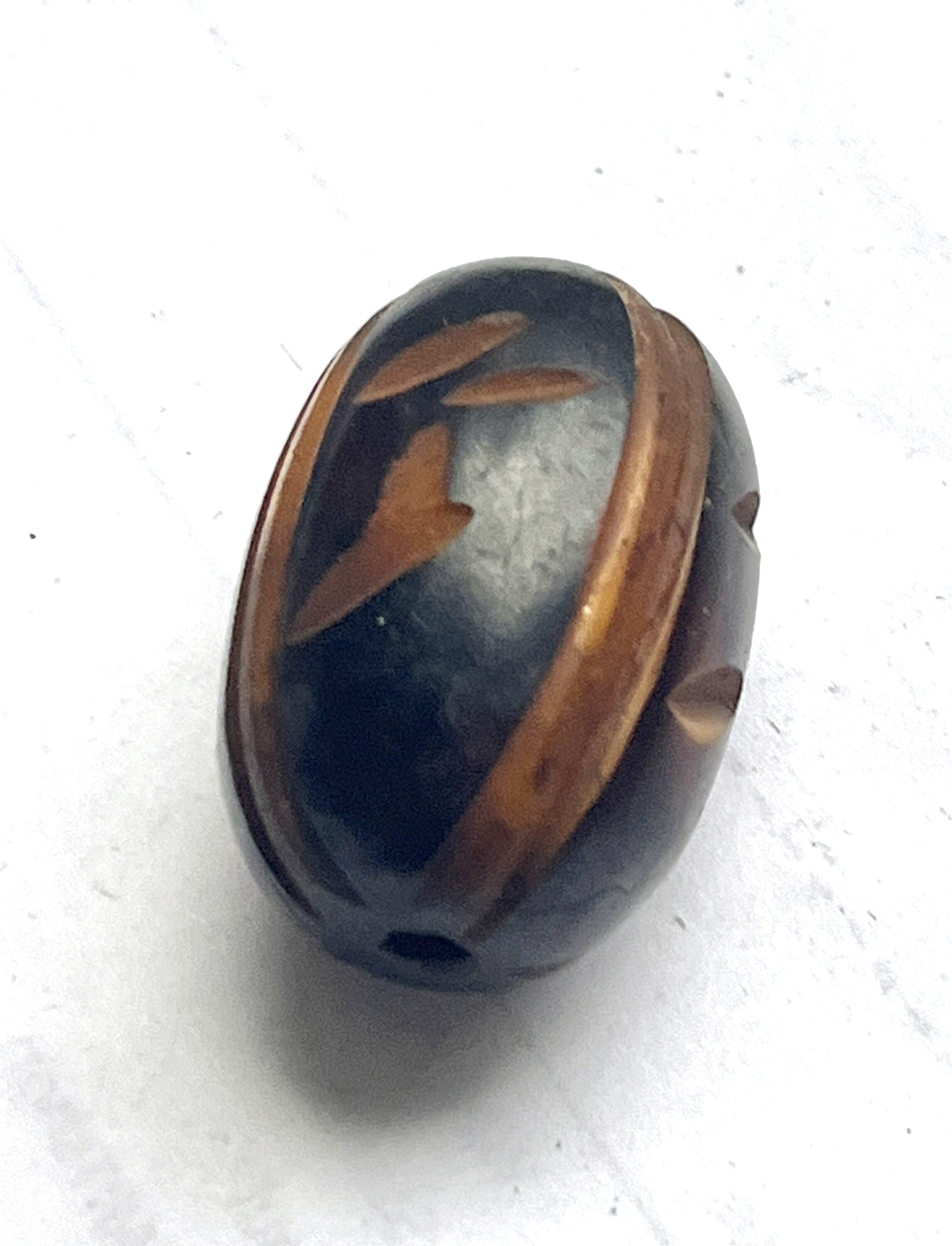
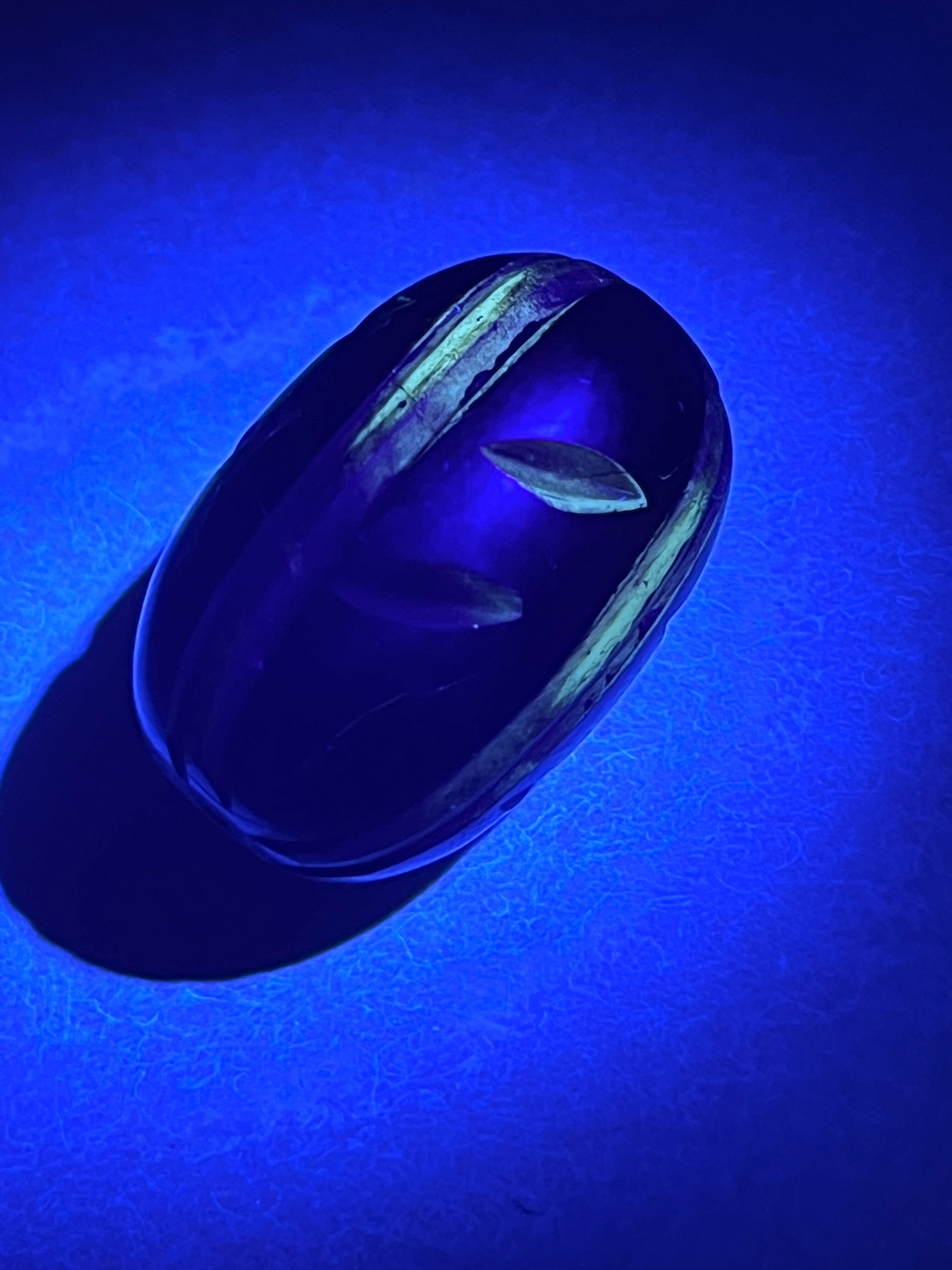
On this subject, I managed to get a very unusual bead (also Indo-Tibetan most recently, but I have no idea what the age is or where/when it wa produced). It was part of a recently strung neckless with cheap, recently made glass tZe like beads and a polypropylene string, but the bead itself is amber. What is unusual is that its surface has been treated, I think, in a way that related in a very dark brown color, except where the stone has been carved, revealing traces of the amber below). It clearly has some cultural meaning, but I am unaware what that might be, or why it was carved this way. I collect ancient beads and I feel I have a pretty good handle on many styles, but this is a first that I have encountered.
It is possible it is not 100% amber, or something with the same specific gravity with a similar fluorescence/buoyancy in salt water (possibly a seed of some sort, I’ve seen seeds carved and used as amulets in Borneo), but all indications are that it’s amber. It’s a head-scratcher appearance-wise but I kinda like it and I def will not alter it.
Here’s a couple pics if interested: