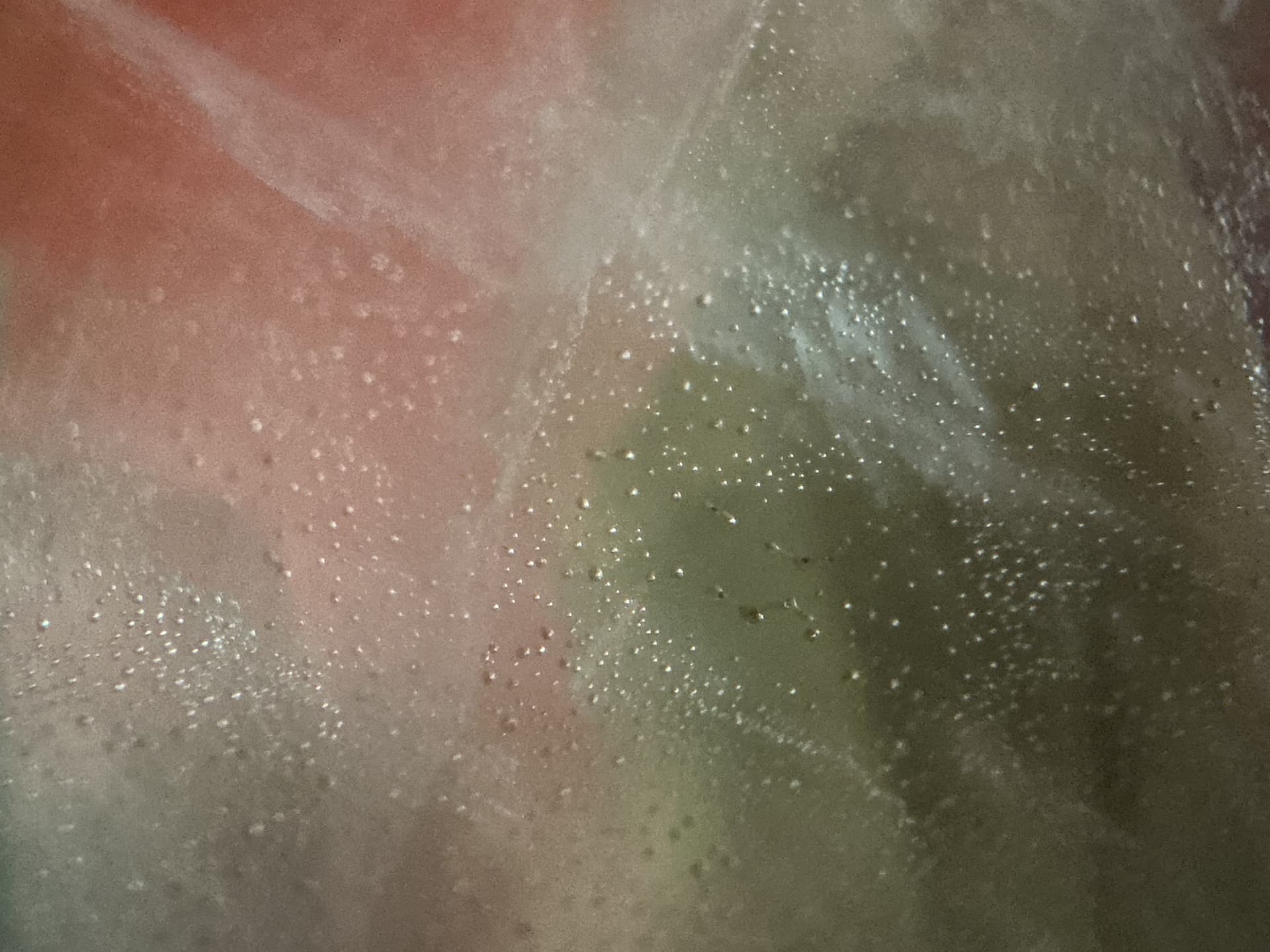
hello this is an inclusion in a yellow stone .are these bubbles or natural inclusions.Thank you .
they don’t look like bubbles, they look like diferent size and shapes
Some heavy info here for you.
Good question — this is exactly the right thing to scrutinise on a yellow stone.
Short answer (clear & honest)
 These do NOT look like gas bubbles in glass.
They are much more consistent with natural inclusions, but with an important caveat about what type of natural inclusion they are.
What I’m seeing in your photo
-
Numerous tiny, rounded pin-points
-
They are not perfectly spherical
-
They are unevenly distributed
-
Some appear aligned along growth or internal stress planes
-
Surface looks slightly diffused because the inclusions are internal, not surface pits
This pattern immediately rules out classic glass.
Why these are unlikely to be glass bubbles
Glass bubbles typically show:
 Perfectly round spheres
Uniform size
Isolated bubbles with clear outlines
“Fish-eye” reflections when tilted
Your image shows:
 Mixed sizes
Slightly irregular shapes
Clustering
No sharp bubble walls
So not glass.
What they most likely ARE
Depending on the stone species, these are consistent with:
 Natural “pinpoint” inclusions
Common in:
-
Sapphire / corundum (yellow sapphire especially)
-
Chrysoberyl
-
Zircon
-
Quartz varieties
These are:
-
Microscopic crystals
-
Fluid remnants
-
Healed fissure pinpoints
 Healed fissures / fingerprint-style inclusions
If under magnification they form:
-
Wispy trails
-
Slight curved lines
-
“Foggy” patches
 This is natural geological healing, not synthetic.
One IMPORTANT red flag to check (very important)
If this is claimed to be:
-
Yellow sapphire
-
Chrysoberyl
-
Heliodor
Then you must confirm they are not flux inclusions (synthetic).
What to do next (simple checks)
 Under 10× loupe:
-
Rotate stone slowly
-
Look for curved growth lines → synthetic
-
Look for metallic shimmer → flux
-
Look for angular crystal shapes → natural
 Under fibre optic light:
-
Natural inclusions scatter softly
-
Glass/synthetic gives harsh, mirror-like flashes
Professional conclusion (based on image alone)
 Natural inclusion structure
Not glass
Species confirmation still required
This is the type of inclusion I expect in natural yellow corundum or chrysoberyl, not man-made glass.
ChatGPT is pretty exceptional at evaluating images. I use it fairly regularly when I’m looking at unknown specimens. It’s also super helpful for generating information for training.
AI, if its here might aswell use it to our advantage.
AI is extremely helpful in normal well known subjects. Even as far a designing substation wiring and the formulas for such. I’m an electrical engineer retired and have been working with the Internet and computers since 1976. I love the progress. I am curious as to how good AI is on stone identification. I’m sure with enough clues it will be a hundred percent. If you care to elaborate about how you use it and such please start a new post or message me so I don’t cause a pirating of the OPs post. Thanks
Thank you for your replies.. I gave the stone to igs they gave it back as undetermined. It’s isotropic , checked in a polarascope. I don’t know what to do next . I have like 4 of the similar ones .
I found several “IGS” labs, but this was the only one listed for gemological testing: https://igswisslab.com
Is this is the lab that returned an “undetermined” result for your stone?
This stone has some color zones. Are they stratified like striae, or large visible patches viewed from different viewpoints?
Have you done any other diagnostic tests like SG and RI? Those could be very helpful in narrowing down possible species.
I think you have posted this image before in a topic discussing corundum. But I don’t remember if this was taken under microscopic magnification / loupe. How large is the field of view? Knowing a scale of size for the inclusions would be helpful.
What type of light was used for the image? Polarized, Bright field, Dark Field? Was it using direct illumination or diffused?
For the polariscope test; what indicators provided evidence that the stone is isotropic?
Sorry for soo many questions. Just very curious about what data is available and really puzzled why the lab stated it was “undetermined”.
Cheers!
hi thank you for your reply.its not igs but igi in dubai.I did buy a polarascope and refractometer.but dont have anything to test specific gravity.In the polarascope it was like mostly dark with a dull moving area.and in refractometer i could not get any proper reading so i thought i should give it to the lab.and it had a dull orange pink flouresence.
AI is good if you know your subject relying, on Chatgpt, and you don’t have real gemology knowledge ,is a Red Flag if you can’t test a sapphire know technical info about gemology how will you know the information is right i keep hearing people saying google search i say to anyone yes Ai is good but you need to know that professionals do the training and study so when your being told its synthetic SG is 3.5 and for Ruby then you get the point
Thanks for the clarification. I remember you mentioned being in/near Dubai. I am glad you found the IGI lab there, but it’s unfortunate they returned a “undetermined” result. 
Did they provide a report or reason why?
As for the Refractive Index test, if it couldn’t be determined, its possible the stone’s RI might be above the scale limit of your instrument. How confident are you with using the refractometer? Have you used it to test other stones?
I struggled for a long time while learning how to do the RI test properly. My refractometer is not the best quality instrument and has a small ocular viewport. Have to get really close to the instrument to view the scale properly.
The orange-pink fluorescence is interesting. Do you know what UV wavelength the stone reacts to? Long-wave UVA (~365nm) or Mid-wave UVB (~290nm)? (You may have told me this before so I apologize for asking again…  )
)