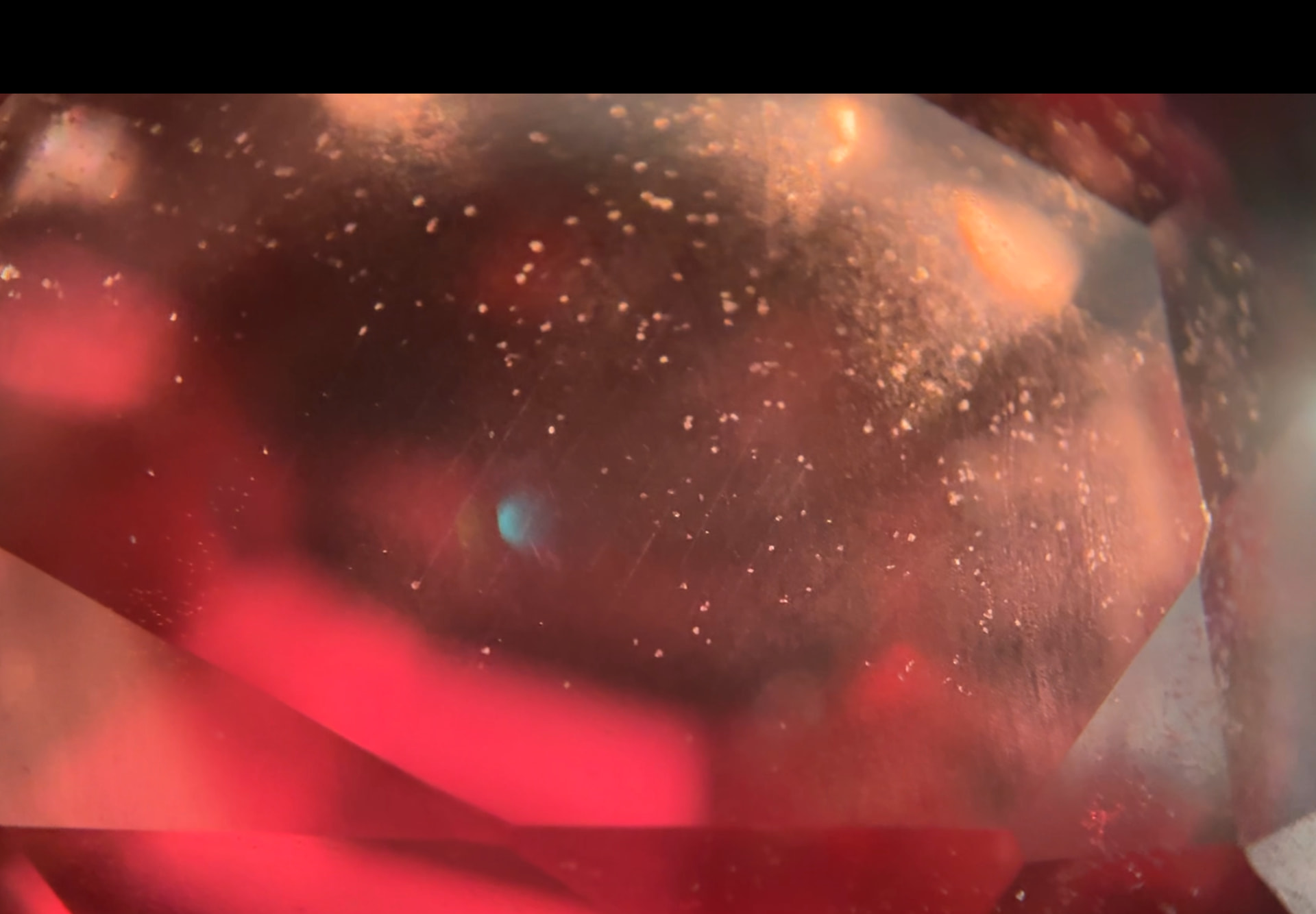
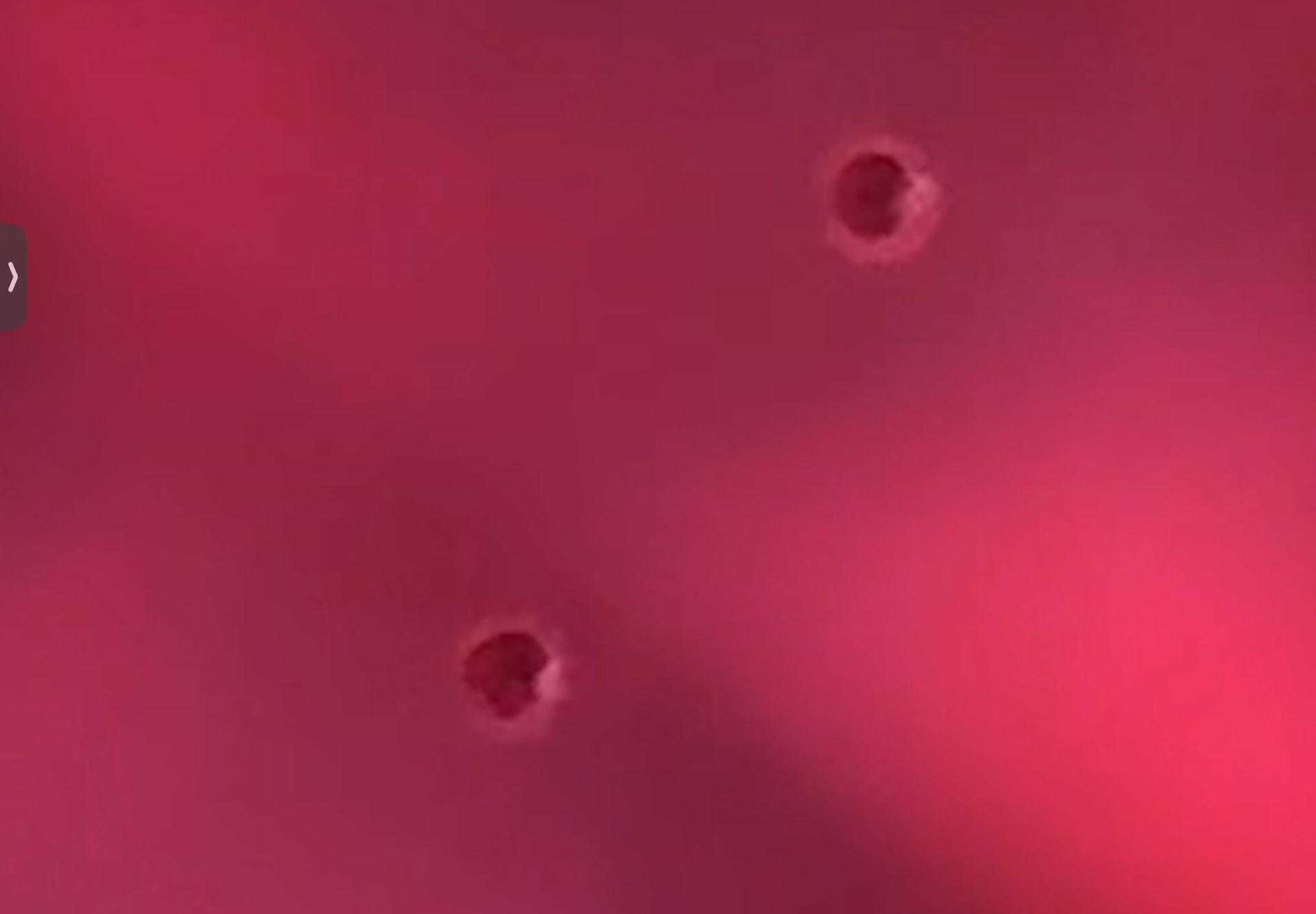
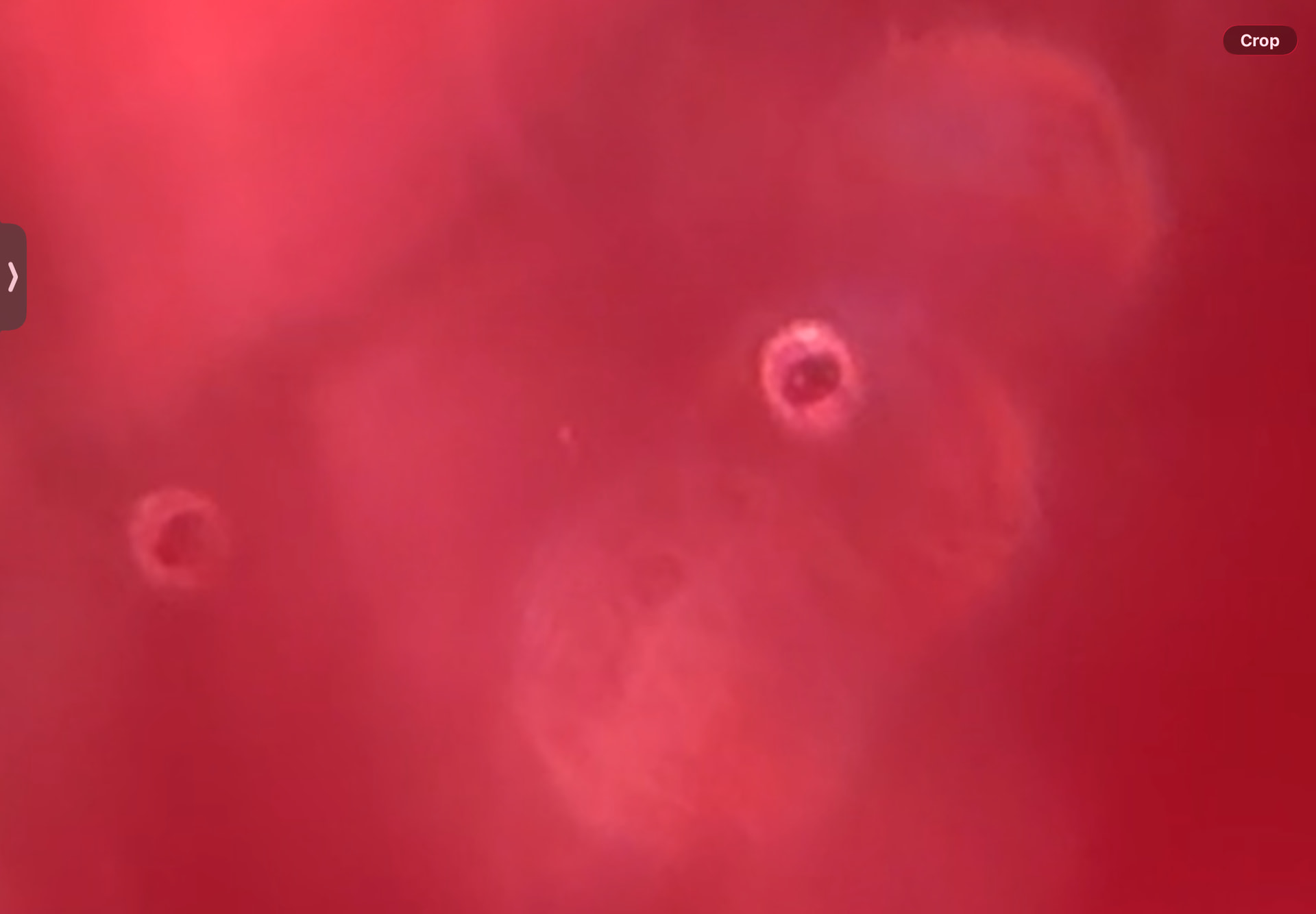
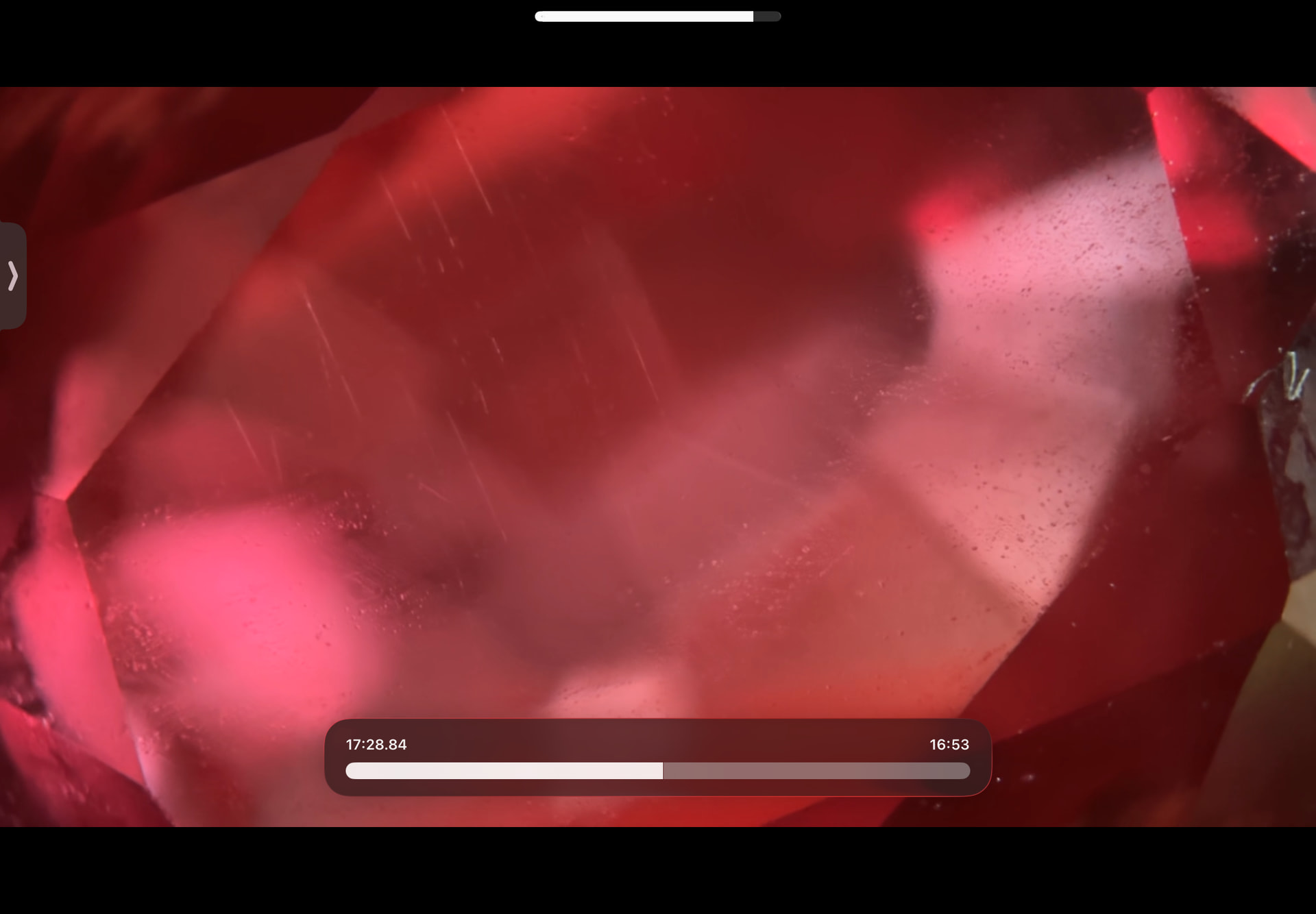
Hello,I need help identifying these inclusions please.thank you.Its a sapphire.
Hi Nirmala,
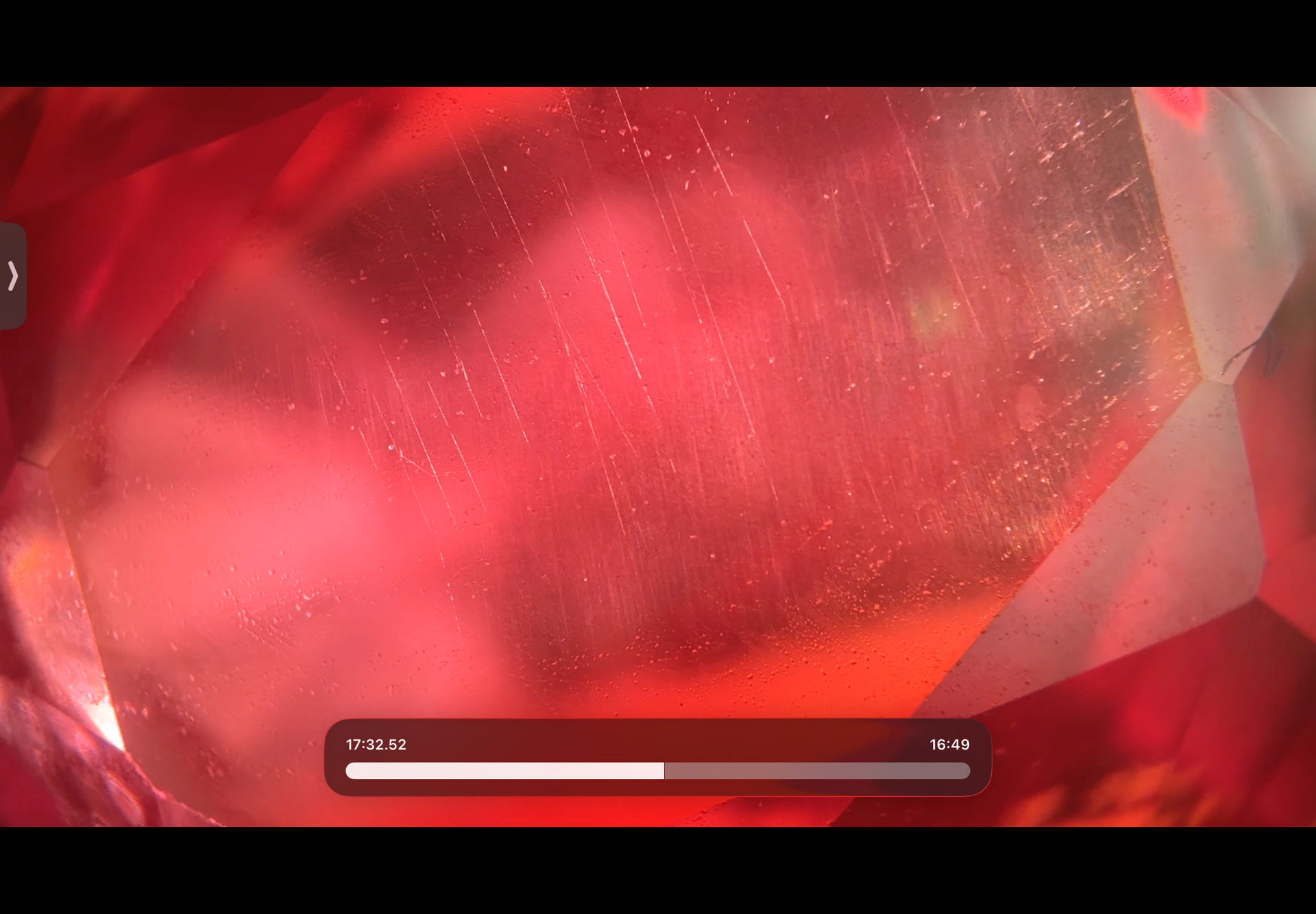
It is difficult to see enough detail on the two spherical inclusions to be sure, but looks like colorant globs that are surrounded by thin halos. Have you determined if this stone is lab-grown or natural?
The image above is difficult to see any detail within the stone, but it looks like there are surface scratches and what looks to be strands of bubbles within the stone.
Cheers!
Thank you for your reply,I’m trying to figure out if it’s lab grown or natural. It’s gives readings for a sapphire. With the color it’s more a padparadsha but natural or synthetic I have to figure out..I read that nickel is added to synthetic padparadshas for the yellow and it shows up in spectroscope.Any suggestions please do help. I do have a spectroscope and can check but I’m not sure I know what to look for in the spectroscope for a pad sapphire..
A Padparadscha’s colors are typically caused from Cr and Fe. I haven’t seen any literature specifically discussing Ni and Ti dopants for lattice diffusion treatments outside of the AI search content and cited links below:
Through a handheld diffraction grating spectroscope, natural Padparadscha’s visible light absorption sample exhibits a typical chromium- and iron-related corundum spectrum: a general cutoff in the violet/blue region, a strong absorption band centered near 450–475 nm (responsible for the yellow-orange component), and distinct chromium lines or a doublet in the deep red around 692–694 nm accompanied by broad green absorption.
A synthetic Padparadscha sapphire looks radically different from its natural counterpart. Synthetic variants typically lack the complex iron-related bands found in natural gems, presenting a remarkably clean, high-transmission spectrum dominated purely by chromium and deliberate synthetic dopants like titanium or nickel. [1, 2, 3]
Spectroscopic Key Markings
- Absent Iron Lines: Unlike natural fancy sapphires, there is no distinct 450 nm, 460 nm, or 471 nm dark line triplet in the blue region. The blue zone remains entirely bright and clear.
- Aggressive Chromium Profile: Strong, broad absorption blankets the green-yellow center (540–560 nm). A broad absorption band cuts off the deep violet (~410 nm).
- Blazing Fluorescent Doublet: In the deep red region (694 nm), synthetics show a fluorescent emission line that glows intensely red, noticeably brighter than natural stones under identical light.
Detecting Nickel (Ni²⁺ or Ni³⁺) in a Padparadscha sapphire using a handheld diffraction grating spectroscope is highly diagnostic. Nickel is not a natural coloring agent in corundum. Its presence explicitly points to artificial surface lattice diffusion treatment or synthetic manufacturing designed to force an orange color component into the gemstone. [1, 2, 3, 4]
The Nickel Spectral Signature
When nickel is artificially diffused into sapphire, it creates unique absorption bands that disrupt the normal pink-to-orange balance of a natural gem.
- The 450–480 nm Yellow-Orange Block: Nickel introduces a broad, strong absorption band peaking in the blue-violet region (~450 to 480 nm). Through a diffraction spectroscope, this appears as a heavy, dark shadow cutting off the blue end of the rainbow, which masks the stone’s natural light transmission and forces a synthetic orange hue.
- The 550–560 nm Green Window: Nickel creates an absorption band in the green region. When mixed with chromium (which provides the pink color), this broadens the green absorption zone, making the center of the spectrum look muddy or significantly blacked out compared to a natural stone.
- The 630–650 nm Orange-Red Blur: Depending on the oxidation state (Ni²⁺ in a tetrahedral or octahedral distortion), a faint, broad shadow can sometimes be observed in the orange-red boundary. [1]
Natural vs. Nickel-Diffused Spectrum Comparison
Because handheld diffraction spectroscopes do not show numerical nanometer markings, you must compare the relative positions of the dark bands across the rainbow:
Feature / Region Natural Padparadscha Sapphire Nickel-Diffused Sapphire (Treatment/Synthetic) Blue Region (450–470 nm) Clear transmission or a few thin, sharp iron (Fe³⁺) lines. A heavy, broad dark absorption patch blocking the blue entirely. Green Region (500–560 nm) Moderate, diffuse shadow allowing some green light to pass. A deeply darkened, expanded block that merges with the blue shadow. Red Region (694 nm) Faint, sharp chromium doublet; mild or soft fluorescence. Sharp chromium lines masked by an unnaturally bright, fiery red glow under intense light. Diagnostic Testing Limitations
While a handheld diffraction spectroscope can give you a strong warning sign—such as a broad blue-green blackout without sharp iron lines—nickel concentration from lattice diffusion is often concentrated in a micro-thin layer on the stone’s surface. [1]
Advanced gemological laboratories confirm the presence of nickel using UV-Vis-NIR spectrophotometers or trace-element chemical analysis like LA-ICP-MS to definitively catch low-parts-per-million levels of treatment.
I’m not very keen with using AI to search for literature but lately, it has become a centric tool and I hesitate to trust the resultant content.
I have some rough lab-grown material displaying the orangey-pink Padparadscha hue. I don’t have a camera setup to display the spectra through my hand-held spectroscope, but will see if I can put something together to image it. The rough material shouldn’t show any nickel spectra, but should be able to see a lack of Fe. 
Oh wow, thank you sooo much .. I’ll check it and let you know and spectrum of your synthetic will be so helpful.Thank you ..thank you so much .
Do check the uv of the synthetic padparadsha too please..
Have you done an immersion test on the stone? If a diffusion treatment was done you could see one of two conditions.
- Diffusion treatment should show a darker ring around the edge of the stone when the table is face down in the immersion fluid.
- Beryllium treated stones will have an opposite optical effect. The outer edge will be lighter than the center where the color will look darker.
See this article Corundum treatments for good visuals on immersion testing.
Almost ready to start imaging the absorbance spectra for the synthetic rough I have. Apologize for the time it has taken to get some mages together.
For UV testing, I only have a 365nm source. My SW UV has not arrived yet.  When that arrives, I’ll take comparison images for both wavelengths.
Hi Troy, no I havnt done diffusion test.. how do I do it, I’ll google and I got the geometrix deep uv too .. and lw and sw ..
1 Like
I use AI daily in the aviation restoration industry. It’s a great tool BUT you have to have enough knowledge of the subject to call it out when it makes mistakes. It’s accurate in most of the things I ask it but last week on a 1946 Air coupe it was incorrect about the back of the seat information. Also it is very important on how you frame the question and how much true information you use in framing the question. Like I said it’s a wonderful tool just like a hammer but it will still smash your thumb on occasion. Lol lol.
1 Like
Understanding how specific a question needs to be framed, is key. I agree with that 100%.
When gathering information such as I did earlier, the intent was to find plausible references to begin learning more about Nirmala’s question/comments on lattice diffusion and why synthetic corundum with padparadscha hues require stronger chromium content and a lack of iron. (another rabbit hole)
Some of the context of my initial search seems to indicate difference of opinions between referenced sources. I’m still new to the diffusion treatments of corundum, so it helps when questions are asked in the group forum to kick-start a learning session.
Cheers!
Yes I agree completely about questions in public forums. It’s a great or in my opinion the best way to kick off a learning experience. Have you tried Luxxle AI? It’s the AI the government research librarians use. I have a friend who is at the top of the ladder in government library services. It’s not exactly what we think when we think of a library or librarian. Lol. I like it because it’s not filtered by the latest political trends or social media fades. I have it set up on one of the browsers on my phone and PC. It’s free to use. The speaking a question is a little slower and different than Google or the others but it works well. Years ago the university of California did a study on gases that blocked heat. It used to be on the front page of a Google search. Since climate change is the latest fade it is on page 27. It basically states that the university of California said CO2 is not a heat blocking or absorbing gas. Lol. The Luxxle search brings it up very quickly. Lol. Anyway try Luxxle and see what you think.
Nirmala,
Quick update on my effort. Found some issues with my hand-held spectrometer:
- The diffraction grating appears to be damaged and several very narrow bands of wavelengths are not being displayed. Looking to see if its possible to replace the grating.
- When attempting to test the synthetic material, discovered the hand held unit really needs to have a dark chamber to block out stray light. Working on that but it is taking longer to produce good images.
Still working on the test setup and hopefully in the next few days the SW UV lamp will arrive finally. 
Have you made any progress in doing an immersion test on your stone?
Cheers!
Thank you Troy .i havnt done the immersion test , will do it today.. Am eagerly waiting for the spectrum of ur stones.. thank you for the effort, im grateful .