Thank you for the thoughtful reply, I appreciate your perspective. I certainly do not want to stir up controversy, I know this can be a touchy thing in geology. I certainly could have chosen differently terms in my post, but I am pretty confident the points I made are quite well supported by the research. Microbes and bacteria are indeed essential to a great number of geological processes that were once thought to be geothermal (ie, non-biological, in this sense). That is not to say that geothermal, climatic, etc. forces are not also essential factors in mineral formation (and processes like erosion, etc), I hope that was not how my post reads. My point is/was roughly that these non-biological factors are not at all sufficient to explain a a great number of such processes, including the bio mineralization of a rapidly glowing list of minerals, many of which are indeed considered “gemstone” or gemstone minerals (agate, carnelian, and even pearls, to name a few - see bottom link). The thing with discoveries like this is not so much the current state of knowledge (in this case of the absolute number of minerals and processes with essential biological dimensions), but the trend. Here’s a rough sense of those trends from Pubmed, the first a chart of the publication of papers on bio mineralization, the second on MICP (microbial induced calcite precipitation, a subset of the former, as I’m using the terms:

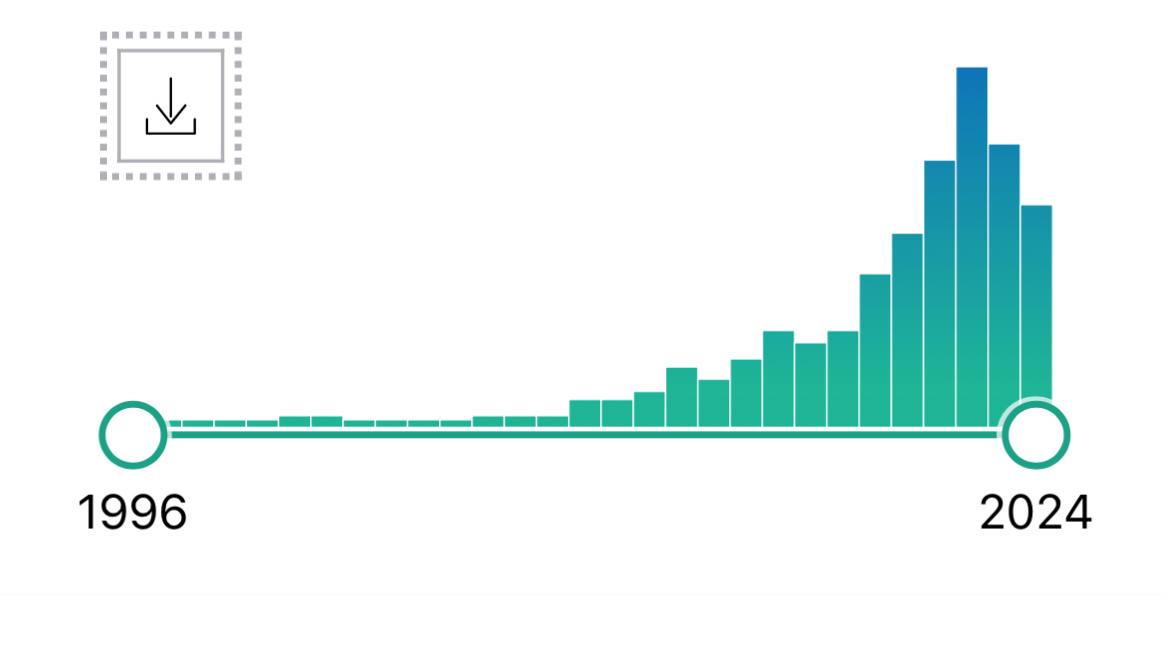
Of course, theae papers cover more than just gemstones or even minerals, but that speaks to the growing awareness of the breath of such processes, which is hard to really dismiss, IMHO.
It’s interesting to me that the role of microbes in the production of minerals and other hard, mineral like processes was quite well known in ancient times (Strabo and Horodotus both describe it, but not using thai term), so it’s not new knowledge, nor does it seem particularly controversial. I guess I was just interested in hearing what others may think of this topic in the gemstone world, and I appreciate your reply.
Here’s a few papers, just by way of context. There are many (I understated the number by using “yearly” in that sentence), and it’s a fascinating field:
https://www.sciencedirect.com/science/article/abs/pii/S1084952115001627